How Oil Stains Affect Epoxy Floor Installation
Oil stains are extremely common on garage floors.
A vehicle develops a small leak, a little motor oil reaches the
concrete, and over time the dark spot becomes something you barely
notice.
But if you’re planning to install an epoxy floor, that old oil stain
suddenly becomes much more important.
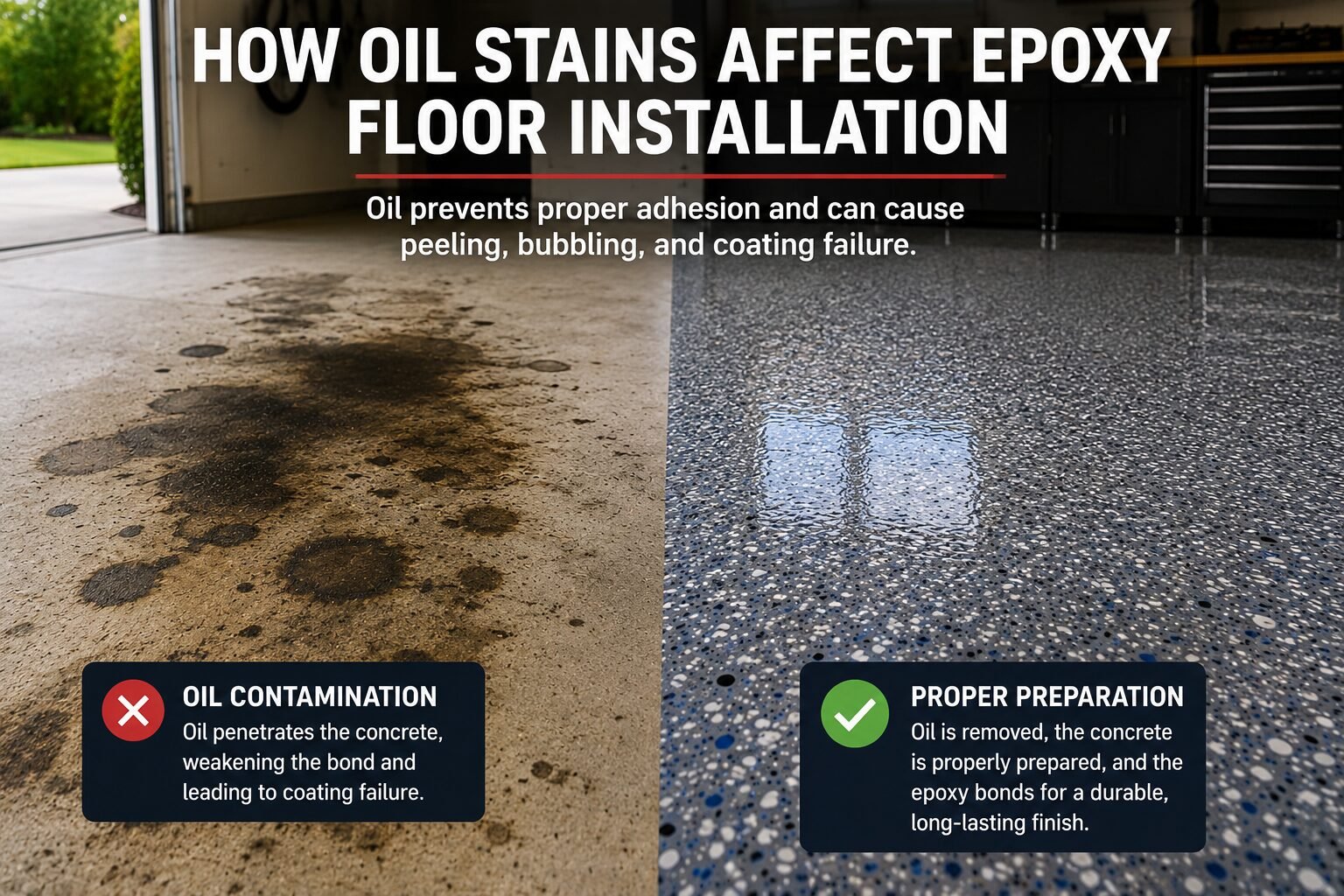
Oil contamination can interfere with the bond between epoxy
and concrete. Because concrete is porous, oil may penetrate
below the visible surface rather than simply sitting on top. If
contaminated concrete isn’t properly evaluated and prepared, the coating
may develop adhesion problems later.
That doesn’t necessarily mean an oil-stained garage floor can’t be
coated.
It means the contamination needs to be addressed before the
epoxy is installed.
Here’s what homeowners should know.
Why Are Oil Stains a
Problem Before Epoxy?
Epoxy flooring depends on adhesion.
For a coating system to perform properly, it needs a suitable
concrete surface to bond to.
Oil can interfere with that process.
Instead of the coating bonding directly to clean, appropriately
prepared concrete, contamination can create a weak area between the
concrete and coating.
The finished floor might initially look perfectly normal.
Problems may not appear until later when vehicle traffic, hot tires,
temperature changes, or other stresses expose the weak bond.
Possible problems include:
- Peeling
- Delamination
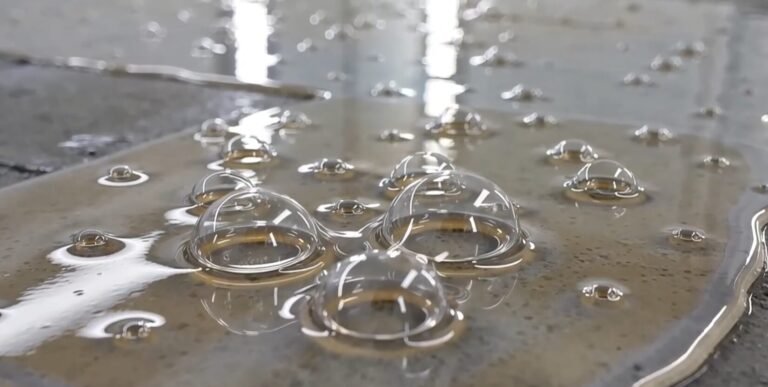
- Blistering
- Fisheyes or surface defects
- Localized coating failure
That’s why old garage-floor oil stains shouldn’t simply be hidden
beneath epoxy.
Why Does Concrete Absorb Oil?
Concrete may look solid, but it contains pores and small
pathways.
When motor oil or another automotive fluid remains on the surface,
some of it can penetrate into those pores.
How deeply contamination travels depends on factors such as:
- How porous the concrete is
- How long the oil remained
- How much oil was spilled
- Whether the concrete was previously sealed
- The type of contaminant
- The age and condition of the slab
A fresh spill and a stain that has accumulated for ten years aren’t
necessarily the same preparation problem.
Can You Epoxy Directly
Over an Oil Stain?
Applying epoxy directly over obvious oil contamination is generally a
bad idea.
Cleaning and surface preparation should come first.
Even if a coating appears to stick initially, contamination
underneath can compromise adhesion.
This is particularly important in garages because the contaminated
areas are often exactly where vehicles park.
Those same sections later receive repeated pressure and heat from
tires.
The better approach is to determine how severe the contamination is,
clean it appropriately, mechanically prepare the concrete as required,
and evaluate the surface before coating.
Does Cleaning Remove All the
Oil?
Sometimes visible staining remains even after contamination has been
substantially addressed.
This creates an important distinction:
A stain and active contamination aren’t necessarily the same
thing.
Concrete can retain discoloration from an old spill even after
significant cleaning and preparation.
Conversely, concrete that looks relatively clean could still contain
contamination.
The objective isn’t simply to make the concrete look brand new.
The objective is to create a surface suitable for the flooring system
to bond to.
How Should Fresh Oil
Spills Be Handled?
Fresh spills should be addressed as soon as practical.
Allowing oil to remain on bare concrete gives it more time to
penetrate the surface.
The exact cleaning method depends on the substance and concrete
condition, but the general goal is to:
- Remove excess liquid
- Use an appropriate cleaning/degreasing method
- Remove resulting residue
- Allow the concrete to dry appropriately
- Evaluate the area before coating
Always follow safety instructions for the cleaning products being
used.
What About Old, Deep Oil
Stains?
Older contamination can be more difficult.
If oil has repeatedly leaked in the same parking spot for years,
cleaning only the top surface may not be enough.
Professional preparation may involve a combination of:
- Degreasing
- Repeated cleaning
- Mechanical surface preparation
- Removal of contaminated surface material
- Further evaluation of heavily affected areas
There isn’t one universal cleaning process for every oil stain.
The condition of the concrete determines how much work is
necessary.
Does Diamond Grinding
Remove Oil Stains?
Diamond grinding can be an important part of preparing garage
concrete, but it shouldn’t automatically be treated as a complete
solution for heavy oil contamination.
Grinding mechanically removes surface material and creates an
appropriate concrete profile for many coating systems.
However, if contamination extends deeper into the slab, simply
grinding the surface may expose additional contaminated material.
That’s why heavily oil-stained floors may require cleaning or
degreasing as part of the preparation process rather than relying solely
on grinding.
The best approach combines contamination removal with proper
mechanical surface preparation.
Should You
Degrease Before or After Grinding?
The exact sequence depends on the condition of the floor and the
preparation system.
In many situations, significant grease or oil contamination should be
addressed before mechanical grinding.
Grinding directly through heavy oily contamination can potentially
spread material across the surface or affect preparation equipment.
Additional cleaning or preparation may still be necessary
afterward.
A professional installer should evaluate the slab and determine an
appropriate sequence rather than applying the same process to every
floor.
What Are Fisheyes in Epoxy
Flooring?
Contamination doesn’t always cause the coating to peel
immediately.
Sometimes it affects the coating while it’s being applied.
One possible defect is commonly called a
fisheye.
A fisheye appears when the wet coating pulls away from a small
contaminated area instead of flowing evenly across it.
This can leave a small crater or circular defect.
Oil, silicone, grease, and certain other contaminants can contribute
to surface-tension problems.
If fisheyes appear during installation, simply adding more coating
without addressing the contamination may not solve the issue.
Can Oil Cause Epoxy to
Bubble?
Oil contamination can contribute to coating defects and adhesion
problems, but bubbles and blisters have multiple possible causes.
Other causes can include:
- Moisture vapor
- Concrete outgassing
- Mixing technique
- Application conditions
- Improper surface preparation
If an epoxy floor develops bubbles or blisters, don’t automatically
assume oil is responsible.
The failure should be evaluated to determine what’s actually
happening underneath the coating.
What
Happens If Epoxy Doesn’t Bond to Oil-Contaminated Concrete?
The coating may eventually begin separating from the substrate.
This is called delamination.
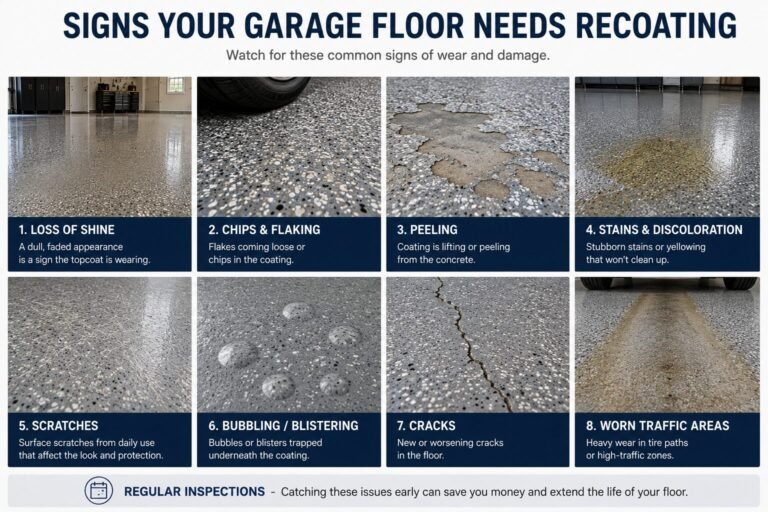
You might notice:
- Peeling edges
- Flaking
- Hollow-sounding areas
- Coating lifting beneath vehicle tires
- Exposed concrete
- Sections that can be removed relatively easily
Once the underlying bond has failed, adding another coat on top
doesn’t restore adhesion to the concrete.
The weak material usually needs to be removed and the substrate
appropriately prepared before repairs are made.
Can Hot Tires Make the
Problem Worse?
They can reveal an existing adhesion weakness.
Vehicle tires can become warm during driving. Once parked, they place
concentrated heat and pressure on relatively small areas of the garage
floor.
If the coating already has poor adhesion because of contamination or
inadequate preparation, tire contact can contribute to visible
failure.
This is one reason the parking areas of a garage deserve careful
preparation before coating.
Can
You Tell Whether Concrete Is Ready for Epoxy by Looking at It?
Not always.
Visual inspection is useful, but appearance alone doesn’t tell the
whole story.
Concrete can look clean while still having:
- Sealers
- Oil contamination
- Cleaning residue
- Previous treatments
- Moisture concerns
- Weak surface material
Likewise, an old discoloration doesn’t automatically mean active oil
remains at the surface.
Professional preparation is about the condition of the
substrate, not simply its color.
What Other
Garage Contaminants Can Affect Epoxy?
Oil isn’t the only concern.
Garage concrete may have been exposed to:
- Grease
- Transmission fluid
- Brake fluid
- Coolant
- Fuel
- Silicone products
- Wax
- Tire-care products
- Household chemicals
- Concrete sealers
- Cleaning products
Some contaminants are obvious.
Others may have been applied by a previous homeowner and be almost
impossible to identify visually.
This is another reason surface preparation is so important.
What If the
Garage Floor Already Has a Sealer?
Concrete sealers can also interfere with a new coating if they’re
incompatible or prevent proper adhesion.
A floor may appear completely clean while still containing a previous
sealer.
Existing coatings and sealers may need to be mechanically removed
before the new flooring system is installed.
Don’t assume bare-looking concrete has never been treated.
Can
an Oil-Stained Garage Floor Still Look Good After Epoxy?
Yes.
An old oil stain doesn’t automatically mean the garage floor is
ruined or unsuitable for coating.
Many stained garage floors can potentially be prepared and coated
successfully.
The important part is addressing the substrate before installing the
decorative system.
Once the floor is appropriately prepared and a compatible opaque
coating system is installed, the old visual stain may no longer be
visible.
But hiding the stain should never be confused with solving the
contamination problem.
Preparation comes first. Appearance comes
afterward.
DIY Epoxy and Oil-Stained
Concrete
Oil contamination is particularly important for homeowners
considering DIY epoxy kits.
It’s tempting to pressure wash or degrease the floor once, wait for
it to dry, and begin coating.
But a garage that has accumulated automotive contamination for many
years may require more preparation.
Before using a DIY system, follow the coating manufacturer’s
surface-preparation requirements carefully.
Pay special attention to:
- Oil-stained parking areas
- Previous coatings
- Sealers
- Cracks
- Moisture concerns
- Surface-profile requirements
Skipping preparation to finish the project faster can dramatically
reduce the value of the coating you’re installing.
How
Professionals Prepare an Oil-Stained Garage Floor
Every slab is different, but a professional preparation process may
involve:
Step 1: Inspect the Concrete
Identify visible oil stains, coatings, cracks, sealers, damaged
areas, and other concerns.
Step 2: Address Heavy
Contamination
Significant oil and grease may require appropriate degreasing or
cleaning procedures.
Step 3: Mechanically
Prepare the Surface
Diamond grinding or another suitable mechanical method may be used to
remove surface material and create the required profile.
Step 4: Reevaluate Problem
Areas
Preparation can reveal conditions that weren’t obvious
beforehand.
Heavily contaminated sections may need additional attention.
Step 5: Complete Necessary
Repairs
Appropriate cracks or surface damage can be repaired as part of
preparation.
Step 6: Remove Dust and
Residue
The prepared floor should be appropriately cleaned before
coating.
Step 7: Apply the Flooring
System
Once the substrate meets the requirements of the selected products,
the coating system can be installed.
The exact procedure should always be based on the concrete and the
products being used.
Oil-Stained Garage
Floors in Charleston, SC
Garage floors in Charleston and the surrounding Lowcountry experience
plenty of everyday automotive use.
Older garages in particular may have years of oil, grease, tire
residue, dirt, and other contamination embedded in the concrete.
That doesn’t necessarily mean the slab needs replacement.
But covering everything with epoxy without first addressing those
conditions can create avoidable problems.
For Charleston homeowners planning a garage upgrade, the condition of
the existing concrete should be evaluated before selecting the finished
color or decorative flakes.
A beautiful garage floor begins with a suitable substrate.
Frequently Asked Questions
Will epoxy stick to
oil-stained concrete?
Epoxy adhesion can be compromised by oil contamination. The concrete
should be appropriately cleaned, prepared, and evaluated before the
coating is applied.
Can
you remove old oil stains from a garage floor before epoxy?
Old contamination can often be addressed using appropriate cleaning
and mechanical preparation methods, although the exact approach depends
on how severe and deep the contamination is.
Will diamond
grinding remove all oil from concrete?
Not necessarily. Grinding removes surface material, but deep
contamination may extend below that surface. Heavy oil contamination may
require additional cleaning and preparation.
Can I
pressure wash oil stains before applying epoxy?
Pressure washing alone shouldn’t automatically be assumed to provide
all the preparation required for an epoxy coating. Follow the flooring
system’s requirements for cleaning and concrete profiling.
Does epoxy cover
the color of old oil stains?
An opaque coating system may visually hide old discoloration, but
covering a stain doesn’t mean contamination underneath has been properly
addressed.
Can oil make epoxy peel?
Oil contamination can interfere with adhesion and contribute to
coating separation. However, peeling can also result from moisture, poor
surface preparation, unsuitable existing coatings, and other
installation problems.
What happens if I
discover oil after grinding?
The affected area should be reevaluated and appropriately treated
before coating. Continuing with the installation simply because grinding
has already been completed could leave a weak section in the finished
floor.
Don’t Hide
Oil Stains—Prepare the Concrete Properly
So, how do oil stains affect epoxy floor
installation?
Oil can penetrate porous concrete and interfere with the bond between
the slab and coating.
That’s why an oil-stained garage floor shouldn’t simply be covered
with epoxy.
The good news is that staining doesn’t automatically disqualify a
concrete floor from being coated.
With proper evaluation, contamination removal, mechanical surface
preparation, and an appropriate coating system, many older garage floors
can be successfully transformed.
If you’re considering a garage floor coating in Charleston,
SC, Epoxy Flooring Charleston can evaluate your existing
concrete and determine the preparation needed before installation.
Explore our Garage Floor Coating services to learn
more about preparing and transforming your Charleston garage floor.