How Long Does Epoxy Flooring Last?
If you’re considering epoxy flooring for your garage, basement,
workshop, or another concrete surface, one of the first questions you
may have is simple:
How long does epoxy flooring actually last?
There’s no single lifespan that applies to every epoxy floor. A
properly installed residential epoxy floor can often provide
many years of service, but its actual lifespan depends
on the condition of the concrete, surface preparation, coating system,
installation quality, traffic, UV exposure, and ongoing maintenance.
A lightly used residential floor and a busy garage exposed to hot
tires, road grit, chemicals, and vehicle traffic won’t necessarily age
at the same rate.
Here’s what determines how long an epoxy floor lasts—and what you can
do to help yours perform well for as long as possible.
What Is the
Typical Lifespan of Epoxy Flooring?
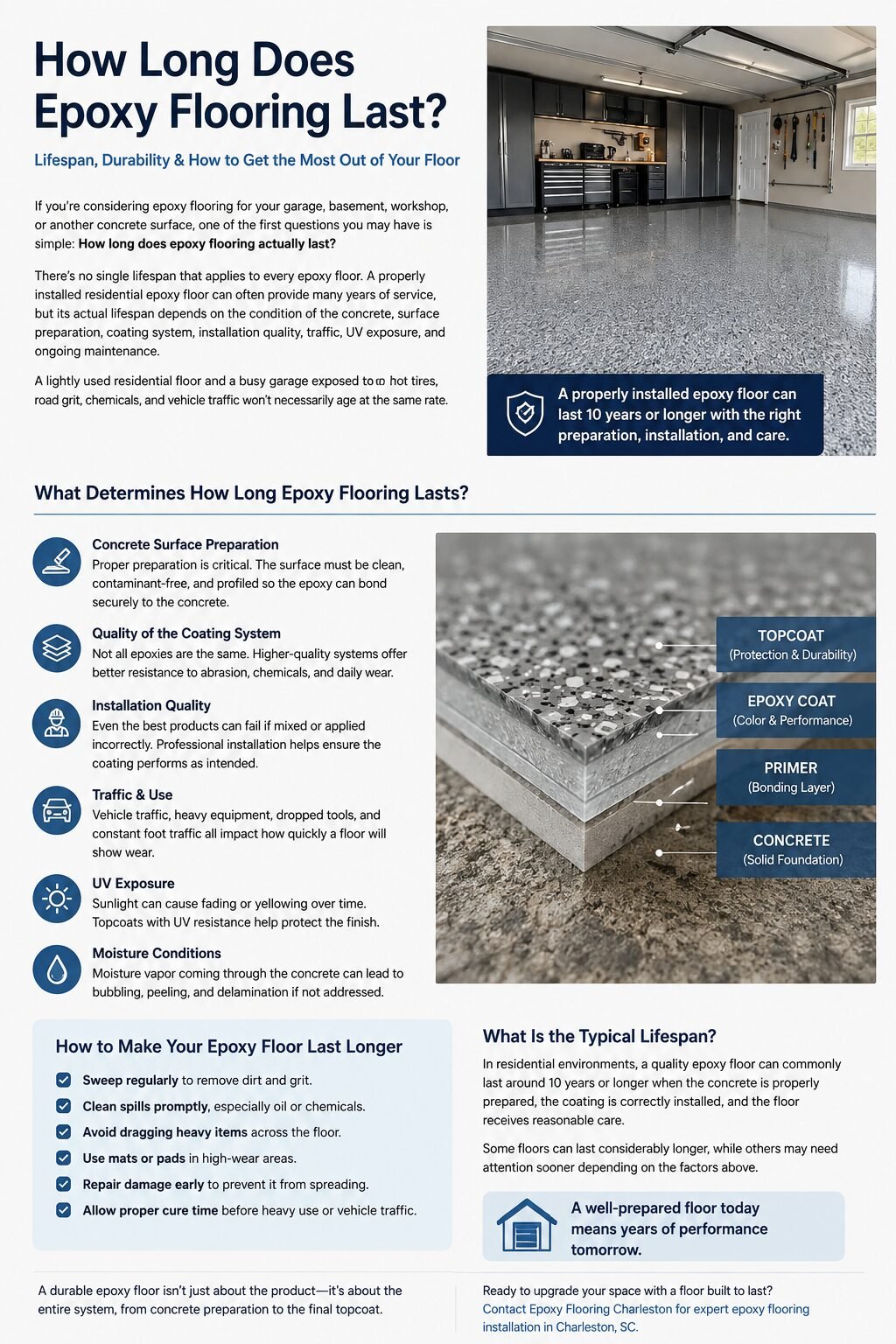
In residential environments, a quality epoxy floor can commonly last
around 10 years or longer when the concrete is properly
prepared, the coating is correctly installed, and the floor receives
reasonable care.
That number shouldn’t be treated as a guarantee.
Some floors can remain functional considerably longer, while others
may develop wear or coating failure much sooner.
The difference often comes down to what’s happening both
above and below the coating.
For example, a basement floor with light foot traffic may experience
far less wear than a garage floor that handles vehicles every day.
Rather than choosing epoxy based only on an advertised number of
years, it’s better to understand the factors that influence its actual
service life.
What Determines
How Long Epoxy Flooring Lasts?
Several factors have a major impact on durability.
1. Concrete Surface
Preparation
Long-lasting epoxy starts with the concrete underneath it.
Before a coating is applied, the surface needs to be appropriately
prepared so the coating can establish a strong bond.
Depending on the slab and coating system, preparation may involve
mechanical methods such as diamond grinding, along with cleaning and
repairs.
If contaminants, sealers, weak surface material, or old coatings
remain between the concrete and the new epoxy, adhesion can suffer.
A floor may look excellent immediately after installation but begin
peeling or delaminating later if the underlying preparation was
inadequate.
That’s why surface preparation can be just as important as the
coating itself.
2. Quality of the Coating
System
Not all products marketed as epoxy flooring are identical.
Different systems vary in:
- Solids content
- Thickness
- Chemical resistance
- Abrasion resistance
- Application requirements
- Intended use
- Topcoat compatibility
A basic DIY coating and a professionally specified multi-layer
flooring system shouldn’t automatically be expected to provide the same
performance.
The right coating should be selected according to where it will be
installed and how the floor will be used.
3. Installation Quality
Even a high-quality product can fail prematurely when installed
incorrectly.
Common installation problems can include:
- Incorrect mixing
- Improper application thickness
- Poor surface preparation
- Applying under unsuitable environmental conditions
- Ignoring recoat windows
- Insufficient curing time
- Failing to address existing concrete problems
Professional installation isn’t simply about making the finished
floor look attractive. Each stage contributes to how the coating
performs afterward.
4. Amount of Traffic
A residential basement used for storage and a two-car garage used
every day place very different demands on a coating.
Frequent vehicle traffic, heavy equipment, rolling toolboxes,
machinery, and repeated foot traffic can gradually wear the surface.
High-use areas may therefore require more attention to coating
selection and maintenance.
5. Hot Tires and Vehicle
Traffic
Garages introduce another source of stress: vehicle tires.
Tires can become hot during driving. Once a vehicle is parked, heat,
weight, and pressure are concentrated where the tires contact the
coating.
If the floor has weak adhesion or hasn’t cured properly, this can
contribute to a problem commonly known as hot tire
pickup, where the coating lifts or separates beneath a
tire.
Proper concrete preparation and allowing the coating system to fully
cure before vehicle traffic are important for garage installations.
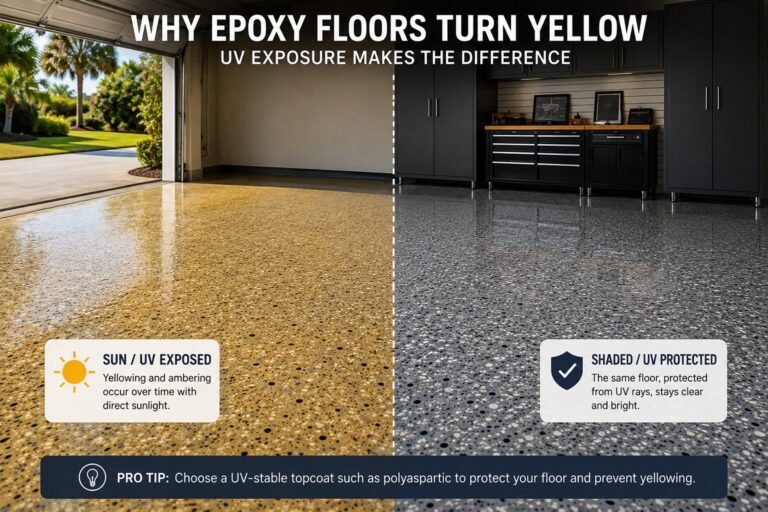
6. Sunlight and UV Exposure
Epoxy can be affected by prolonged ultraviolet exposure.
Depending on the formulation, exposure to sunlight may cause changes
in color or appearance over time.
This is especially relevant around garage doors, entrances, patios,
or other locations where sunlight regularly reaches the floor.
Where UV exposure is expected, the overall coating system—including
any appropriate topcoat—should be selected with those conditions in
mind.
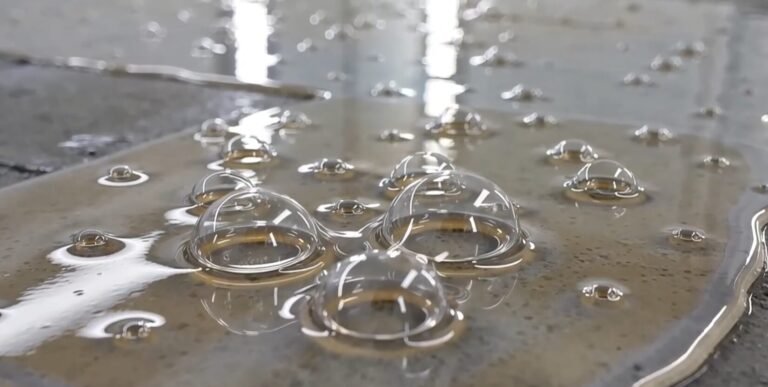
7. Moisture Conditions
Moisture is another factor that can affect coating longevity.
Concrete is porous, and moisture vapor moving through a slab can
create problems for certain coating systems if conditions aren’t
properly evaluated.
Potential signs of moisture-related problems can include:
- Blistering
- Bubbling
- Peeling
- Delamination
- Discoloration
Applying another coating over a moisture-related problem without
addressing the underlying cause may lead to another failure.
How Long Does Epoxy Last
in a Garage?
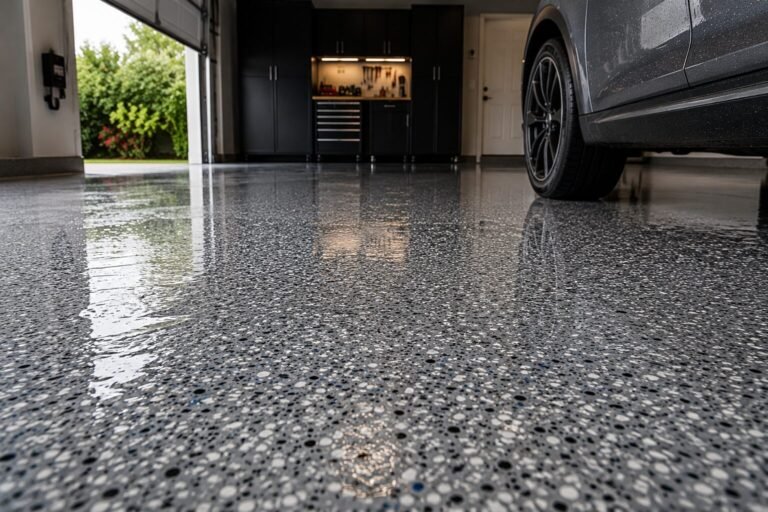
A professionally prepared and installed epoxy garage floor can
provide many years of service, but garages are among the more demanding
residential environments.
Garage floors regularly encounter:
- Vehicle traffic
- Hot tires
- Dirt and sand
- Road salt in some regions
- Oil and automotive fluids
- Dropped tools
- Abrasion
- Temperature changes
Because of these conditions, installation quality becomes
particularly important.
A garage coating applied over poorly prepared concrete may fail much
sooner than a properly installed system, regardless of how expensive the
coating product was.
For homeowners considering a garage floor coating,
it makes sense to evaluate the complete installation process rather than
focusing only on the epoxy itself.
How Long Does Epoxy Last
Inside a Home?
Residential interior epoxy flooring may experience considerably
lighter wear than a garage.
Areas such as:
- Basements
- Utility rooms
- Home workshops
- Storage areas
- Finished concrete spaces
may not face the same combination of vehicle traffic, hot tires, road
debris, and automotive fluids.
With appropriate preparation, installation, and maintenance,
residential epoxy can provide a durable flooring surface for many
years.
The exact lifespan will still depend on how the room is used and the
conditions of the concrete underneath.
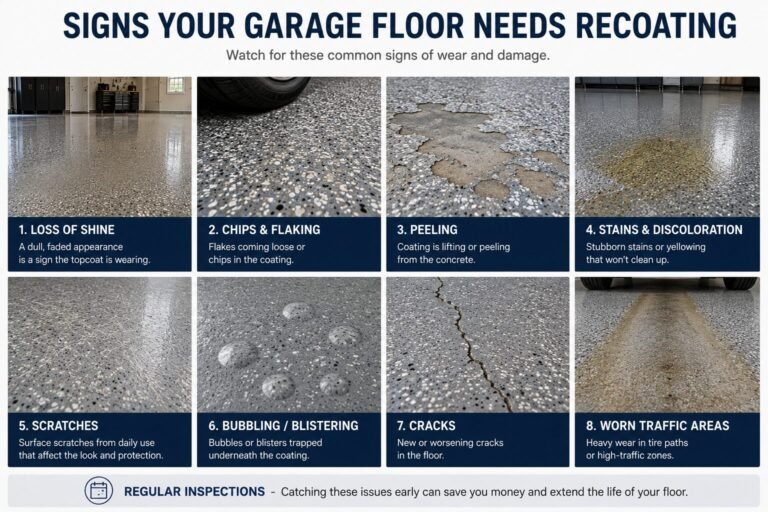
Signs
Your Epoxy Floor May Need Repair or Replacement
An older epoxy floor doesn’t automatically need to be replaced simply
because it has reached a certain age.
Instead, look at its actual condition.
Peeling or Delamination
If sections of the coating are separating from the concrete, the
underlying cause should be investigated.
Localized failure may sometimes be repairable. Widespread
delamination can indicate a larger adhesion or moisture problem.
Excessive Scratching or Wear
Minor surface scratches don’t necessarily mean the entire coating has
failed.
However, heavily worn traffic areas or widespread surface
deterioration may indicate that maintenance, recoating, or replacement
should be considered.
Chipping
Impacts from heavy objects can damage certain areas of a floor.
Small chips may be repairable depending on the coating system and
extent of the damage.
Bubbling or Blistering
Bubbles or blisters shouldn’t simply be covered with another
layer.
They can indicate adhesion, moisture, installation, or substrate
issues that should be identified first.
Significant Color or
Appearance Changes
A coating may remain attached to the concrete while its appearance
changes due to UV exposure, wear, staining, or age.
Whether that requires replacement depends on whether the issue is
cosmetic or affects the floor’s performance.
How Can You Make
Epoxy Flooring Last Longer?
Good maintenance doesn’t need to be complicated.
Sweep Away Dirt and Grit
Sand and small debris can act like abrasives when walked or driven
over repeatedly.
Regular sweeping or dust removal helps reduce unnecessary surface
wear.
Clean Spills Promptly
Oil, automotive fluids, chemicals, and other substances shouldn’t be
allowed to sit indefinitely.
Clean spills using methods and products compatible with your
particular coating system.
Avoid Dragging Heavy Objects
Dragging metal equipment, furniture, machinery, or other heavy
objects across the floor can scratch or gouge the surface.
Lift items where practical or use suitable protection when moving
heavy equipment.
Use Appropriate Floor
Protection
Mats or protective pads can be useful in areas exposed to unusual
levels of wear.
However, mats shouldn’t be used to hide an existing coating failure.
Peeling, bubbling, or delamination should be investigated.
Repair Damage Before It
Spreads
A small damaged area can sometimes become larger when loose coating
continues to receive traffic.
Addressing localized damage early may make repairs simpler.
Follow
Post-Installation Cure Instructions
A newly installed floor may look finished before it is ready for full
use.
Don’t move vehicles, heavy equipment, or other loads onto the surface
until the coating system has reached the appropriate stage of cure
specified by the manufacturer or installer.
Does
Epoxy Flooring Last Longer Than Regular Concrete Paint?
Generally, a properly specified epoxy coating system is designed to
provide greater durability than ordinary concrete floor paint.
Epoxy forms a different type of coating and can offer better
resistance to abrasion, chemicals, and demanding floor conditions
depending on the products being compared.
However, simply choosing epoxy doesn’t guarantee longevity.
A poorly prepared epoxy floor can fail sooner than expected.
Product quality + surface preparation + installation +
maintenance all work together.
Is
Professional Epoxy Flooring Worth It for Longevity?
For homeowners focused on long-term performance, professional
installation can offer important advantages.
A professional flooring project should involve more than applying a
coating with a roller.
The process may include:
- Evaluating the existing concrete
- Identifying previous coatings or contaminants
- Checking for visible damage or potential moisture concerns
- Preparing the concrete appropriately
- Repairing suitable cracks or damaged areas
- Applying a compatible coating system
- Following required curing and recoat procedures
The objective is to create a complete flooring system rather than
simply changing the color of the concrete.
Epoxy Flooring
Lifespan in Charleston, SC
Charleston’s climate can create additional considerations for coated
concrete floors.
Heat and humidity, combined with the conditions found inside garages,
make proper preparation and product selection especially important.
Garages may also experience frequent exposure to hot vehicle tires,
moisture carried in by vehicles, dirt, sand, and everyday wear.
For Charleston homeowners, choosing a floor based solely on the
lowest installation price can overlook the factors that have the
greatest impact on long-term performance.
The condition of the concrete and how the coating is installed matter
just as much as its finished appearance.
Frequently Asked Questions
Can epoxy flooring last 20
years?
It can in some environments, but a 20-year lifespan shouldn’t be
assumed for every epoxy floor. Traffic, surface preparation, coating
quality, UV exposure, moisture conditions, maintenance, and installation
all influence longevity.
How
often does an epoxy garage floor need to be replaced?
There is no fixed replacement schedule. A well-performing floor
doesn’t need replacement simply because it reaches a particular age. Its
actual condition should determine whether repairs, maintenance,
recoating, or replacement are necessary.
Why
does some epoxy flooring fail after only a few years?
Premature failure can have several causes, including inadequate
surface preparation, moisture problems, unsuitable products, incorrect
installation, insufficient curing, or unusually demanding use.
Does epoxy scratch easily?
Epoxy can be scratched, particularly by sharp objects, dragged
equipment, or abrasive debris. The degree of scratch resistance depends
on the specific coating system and any topcoat used.
Is epoxy suitable for
residential garages?
Yes. Epoxy-based coating systems are commonly used on residential
garage floors. The system should be selected and installed for the
conditions it will face, including vehicle traffic and hot tires.
Can an old epoxy floor be
recoated?
Sometimes. The existing coating first needs to be evaluated for
adhesion, damage, contamination, and compatibility with the proposed new
system. Applying a new coating over a failing surface won’t correct the
underlying problem.
Get More Life From Your
Concrete Floor
So, how long does epoxy flooring last?
For residential applications, a properly prepared and installed epoxy
floor can often provide 10 years or more of useful
service, with actual longevity depending heavily on the
environment, coating system, installation, and maintenance.
The biggest mistake is focusing only on the product being
applied.
A long-lasting floor starts with the concrete underneath it.
If you’re considering residential epoxy flooring or a garage
floor coating in Charleston, SC, Epoxy Flooring Charleston can
help you choose an appropriate solution based on your concrete and how
you plan to use the space.
Explore our Residential Epoxy Flooring and
Garage Floor Coating services to learn more about
durable flooring options for your Charleston property.