What Is the Best Garage Floor Coating for Coastal South Carolina?
Choosing a garage floor coating in coastal South Carolina isn’t only
about finding a finish that looks good.
Garages in Charleston and surrounding coastal communities deal with
conditions that can be demanding on concrete and floor coatings,
including heat, humidity, moisture, sand, wet vehicles, strong
sunlight near garage entrances, and everyday vehicle
traffic.
So, what is the best garage floor coating for coastal South
Carolina?
There isn’t one product that’s automatically best for every garage.
In many cases, the strongest approach is a properly prepared,
multi-layer coating system selected for the specific concrete and garage
conditions, rather than choosing a floor based only on whether
it’s called epoxy, polyurea, or polyaspartic.
The coating matters—but the condition and preparation of the concrete
underneath it matter just as much.
Here’s what Charleston-area homeowners should consider.
Why
Coastal South Carolina Garages Need the Right Floor Coating
A garage floor in the Lowcountry faces a different combination of
conditions than a lightly used indoor concrete floor.
Heat
South Carolina summers can be hot, and garage temperatures can rise
considerably during warm weather.
Vehicles also bring warm tires into the garage after driving on
sun-heated roads.
A garage floor coating system should be selected with real vehicle
use and temperature conditions in mind.
Humidity
High humidity is a normal part of coastal South Carolina’s
climate.
Humidity doesn’t automatically cause a floor coating to fail, but
environmental conditions can affect coating application and curing.
Installers need to follow the temperature, humidity, and substrate
requirements of the products being used.
Moisture
Concrete is porous, and moisture conditions within a slab can affect
certain coating installations.
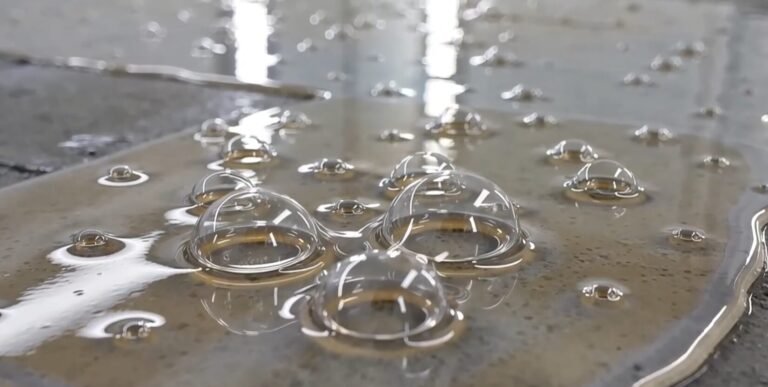
If excessive moisture vapor is present, applying a coating without
evaluating the substrate may contribute to problems such as blistering
or loss of adhesion.
This is why the concrete itself should be considered before
installation.
Sand and Dirt
Living near the coast means sand and grit can easily find their way
into garages.
These small particles can act as abrasives when repeatedly driven or
walked over.
A durable coating system and routine cleaning can help the floor
handle everyday use.
Wet Vehicles
Heavy rain is another reality of living in coastal South
Carolina.
Vehicles can carry water into the garage, creating wet areas on the
floor.
This makes both cleanability and appropriate surface texture
important considerations.
What Types of
Garage Floor Coatings Are Available?
Homeowners will commonly encounter several coating terms while
researching garage flooring.
Understanding the basic differences can make comparing options
easier.
Epoxy Garage Floor Coatings
Epoxy has been used for concrete flooring for many years.
Depending on the formulation and system, epoxy can provide:
- Strong adhesion to properly prepared concrete
- An attractive finished appearance
- Chemical resistance
- Good durability
- Multiple color options
- Decorative flake options
Epoxy can work well as part of a residential garage floor system when
the concrete is properly prepared and the products are appropriate for
the application.
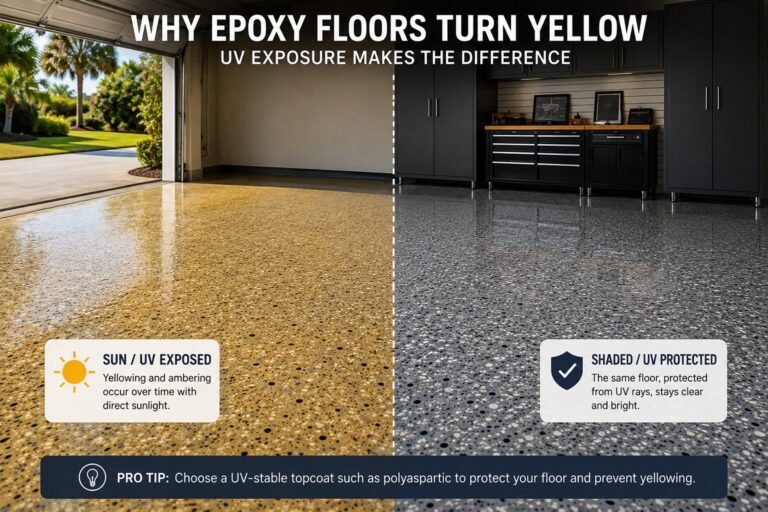
One consideration is UV exposure.
Some epoxy formulations can change color or appearance after
prolonged exposure to sunlight. This can be particularly relevant near
garage entrances where sunlight regularly reaches the floor.
For that reason, epoxy may be combined with other compatible coating
layers depending on the system.
Polyaspartic Garage Floor
Coatings
Polyaspartic coatings are another popular option for garages.
Depending on the particular formulation, they may offer advantages
such as:
- Faster curing
- Good abrasion resistance
- Chemical resistance
- UV stability
- Decorative flake compatibility
Their relatively fast cure can be useful, but it also means
installers may have less working time during application.
That makes proper preparation, mixing, and application technique
especially important.
Polyaspartic coatings are often used as part of multi-layer garage
floor systems rather than being considered solely as a standalone
product.
Polyurea Garage Floor
Coatings
Polyurea is another term homeowners may encounter when comparing
professional garage floor coatings.
Polyurea formulations can provide properties such as flexibility and
fast curing, depending on the product.
As with epoxy and polyaspartic coatings, however, the name alone
doesn’t tell you whether a system is appropriate for your garage.
Different formulations can perform differently.
It’s more useful to evaluate the complete coating
system than to assume every product within one category
performs identically.
Epoxy
vs. Polyaspartic: Which Is Better in South Carolina?
This is one of the most common comparisons homeowners make.
The answer isn’t as simple as saying one material always wins.
A garage flooring system can use different materials for different
layers.
For example, a system may use one type of coating for its bonding
characteristics and another as the finish or topcoat.
When comparing epoxy and polyaspartic systems, consider:
- Concrete condition
- Surface preparation
- Moisture conditions
- UV exposure
- Vehicle traffic
- Desired appearance
- Cure requirements
- Abrasion resistance
- Chemical exposure
- Surface texture
The quality of the installation is also extremely important.
A premium coating applied over poorly prepared concrete can still
fail.
Why Surface Preparation
Matters So Much
If you remember only one thing when comparing garage floor coatings,
make it this:
The coating is only part of the floor.
The concrete underneath it is the foundation of the entire
system.
Garage concrete may contain:
- Oil
- Grease
- Dirt
- Old paint
- Sealers
- Previous coatings
- Weak surface material
- Cracks
- Other contaminants
Applying a coating directly over an unsuitable surface can compromise
adhesion.
Professional preparation commonly involves mechanical methods such as
diamond grinding, depending on the concrete and coating
system.
Grinding can remove unsuitable surface material and create a more
appropriate profile for the coating to bond to.
Surface preparation shouldn’t be skipped simply because the coating
itself is advertised as highly durable.
What About Acid Etching?
Acid etching is sometimes used to prepare concrete, particularly with
certain DIY flooring products.
However, chemical etching and mechanical grinding aren’t the same
process.
Acid etching relies on a chemical reaction with exposed concrete,
while diamond grinding mechanically works the surface.
Existing coatings, sealers, contamination, and variations in the slab
can limit what chemical preparation alone can accomplish.
For professional garage floor installations, mechanical preparation
can provide greater control over the substrate.
Which Garage
Floor Coating Handles Humidity Best?
It’s tempting to look for a single “humidity-proof” coating.
In reality, humidity is only one part of the installation
environment.
The coating manufacturer may specify acceptable ranges for:
- Air temperature
- Concrete temperature
- Relative humidity
- Surface conditions
- Dew point considerations
- Cure conditions
Professional installation means paying attention to these
requirements rather than applying the coating regardless of weather
conditions.
The best system is one that’s appropriate for the concrete
and installed within the required environmental
conditions.
What About
Moisture Coming Through the Concrete?
This is different from humid air inside the garage.
Moisture vapor can move through concrete from below.
If moisture conditions exceed what a coating system can tolerate,
adhesion problems or blistering may develop.
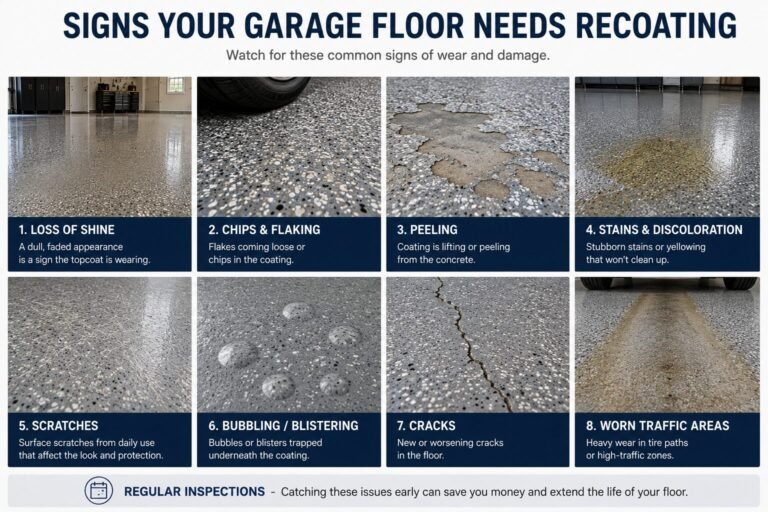
Possible warning signs can include:
- Previous coating failure
- Blistering
- Peeling
- Unexplained damp areas
- Recurring moisture-related problems
If moisture is suspected, it should be evaluated before coating the
floor.
Simply choosing a more expensive coating doesn’t automatically
correct an underlying moisture problem.
What Is Best for Hot Tires?
Garage floors have to handle repeated contact with vehicle tires.
After driving, tires can be warm and place concentrated heat and
pressure on the coating where the vehicle is parked.
If a coating has poor adhesion, this can contribute to hot
tire pickup, where material lifts or separates beneath a
tire.
Reducing the risk starts with:
- Proper concrete preparation
- An appropriate coating system
- Correct installation
- Following cure times before parking vehicles
Choosing a quality product matters, but strong adhesion begins with
the concrete underneath it.
What Coating Is Best for
UV Exposure?
UV exposure deserves consideration in coastal South Carolina,
especially around garage doors.
Sunlight may reach the front portion of the garage for hours
depending on the home’s orientation.
Some coating materials are more UV stable than others.
Where sunlight exposure is expected, a compatible UV-stable finish or
topcoat may be appropriate.
This can help maintain the appearance of the flooring system over
time.
What About Slip
Resistance During Heavy Rain?
Charleston-area garages can regularly receive wet vehicles.
A very smooth floor can become slippery when water, oil, soap, or
other liquids are present.
If traction is a concern, the coating system can potentially
incorporate:
- Decorative flakes
- Surface texture
- Compatible slip-resistant additives
The goal isn’t necessarily to create the roughest possible floor.
Heavy texture can make cleaning more difficult.
For residential garages, a balance between traction, comfort,
appearance, and cleanability is usually preferable.
Are
Decorative Flake Floors Good for Coastal Garages?
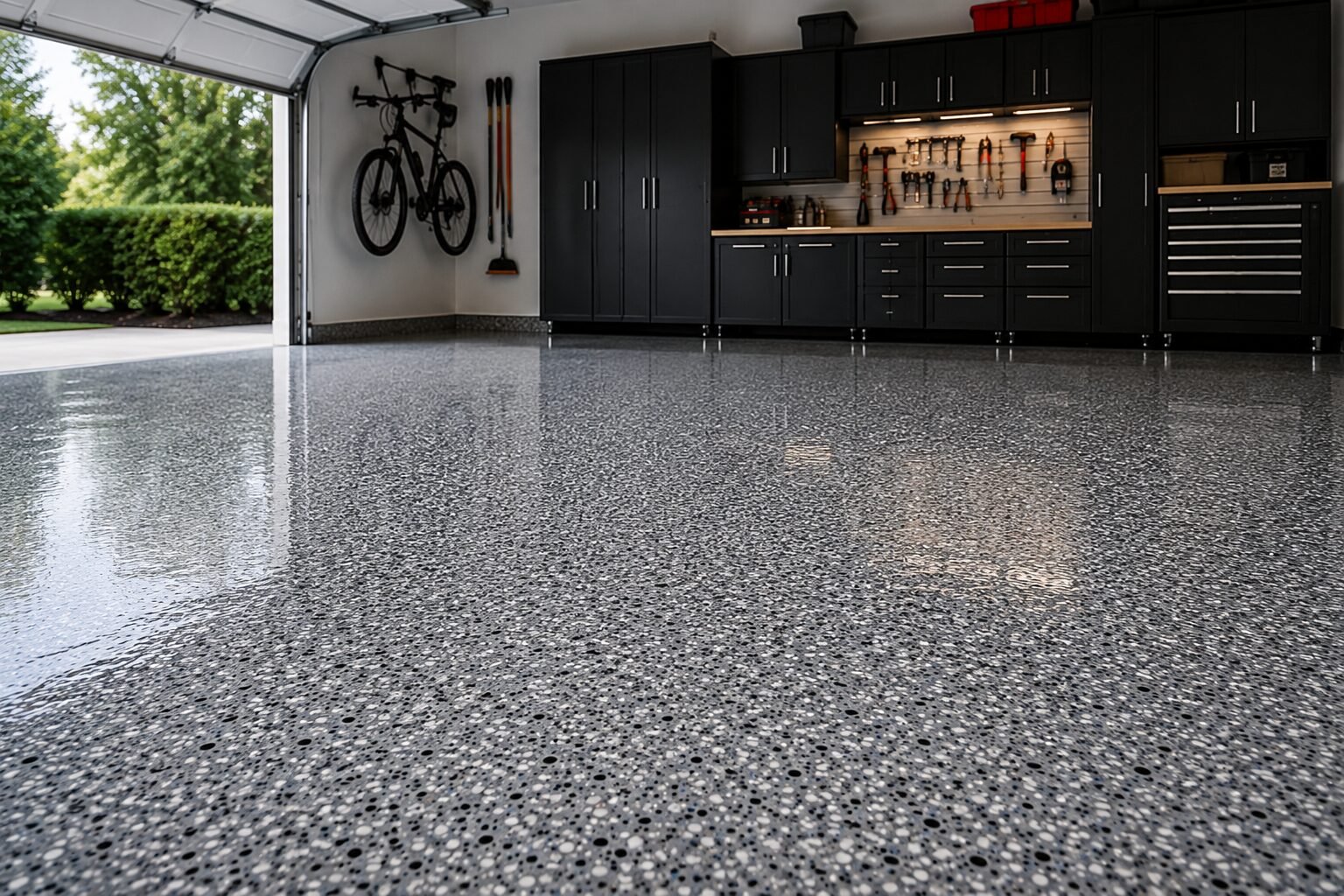
Decorative flake systems can be an excellent aesthetic option for
residential garages.
They offer color variation and visual texture while helping disguise
small amounts of everyday dirt and debris.
That’s useful in garages where sand, dust, and road debris are
common.
Popular neutral combinations include:
- Light gray
- Medium gray
- Charcoal
- Black and white
- Tan and beige
The color and flake blend should ultimately complement your garage,
home, cabinets, lighting, and personal preference.
What About Cracks in the
Garage Floor?
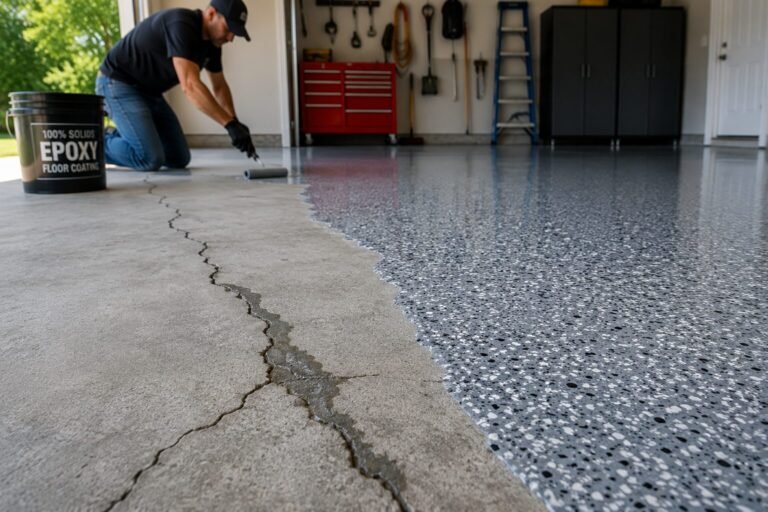
Cracks don’t automatically mean your concrete can’t be coated.
Many garage slabs have minor cracks.
However, cracks should be evaluated before coating. Learn more about coating a garage floor that has cracks.
Stable cracks may be repairable during preparation, while cracks
showing significant movement or vertical displacement may require
further investigation.
Simply rolling a coating over an untreated crack doesn’t address the
underlying condition.
What
Is the Best Garage Floor Coating for Charleston Homes?
For many Charleston-area homeowners, the best solution isn’t simply
choosing epoxy vs. polyaspartic vs. polyurea based on a
product name.
A better approach is choosing a complete flooring system that
provides:
- Proper evaluation of the existing concrete
- Appropriate mechanical surface preparation
- Necessary crack and surface repairs
- Products suited to the concrete and garage conditions
- Appropriate UV considerations
- Suitable texture for traction
- Correct application and curing
The strongest garage floors are built as systems.
DIY vs. Professional
Garage Floor Coatings
DIY kits can be attractive because of their lower upfront cost.
For some homeowners and applications, they may be a reasonable
option.
However, professional garage floor installation generally involves
equipment and preparation procedures that can be difficult to reproduce
with a basic DIY kit.
The biggest difference may not be the act of rolling the coating onto
the floor.
It’s everything that happens beforehand.
Professional preparation can include:
- Inspecting the concrete
- Removing existing coatings
- Addressing contamination
- Mechanical grinding
- Repairing appropriate cracks
- Evaluating problem areas
- Selecting compatible coating layers
When comparing costs, consider the entire installation rather than
comparing only the price of coating material.
How Long Should a
Garage Floor Coating Last?
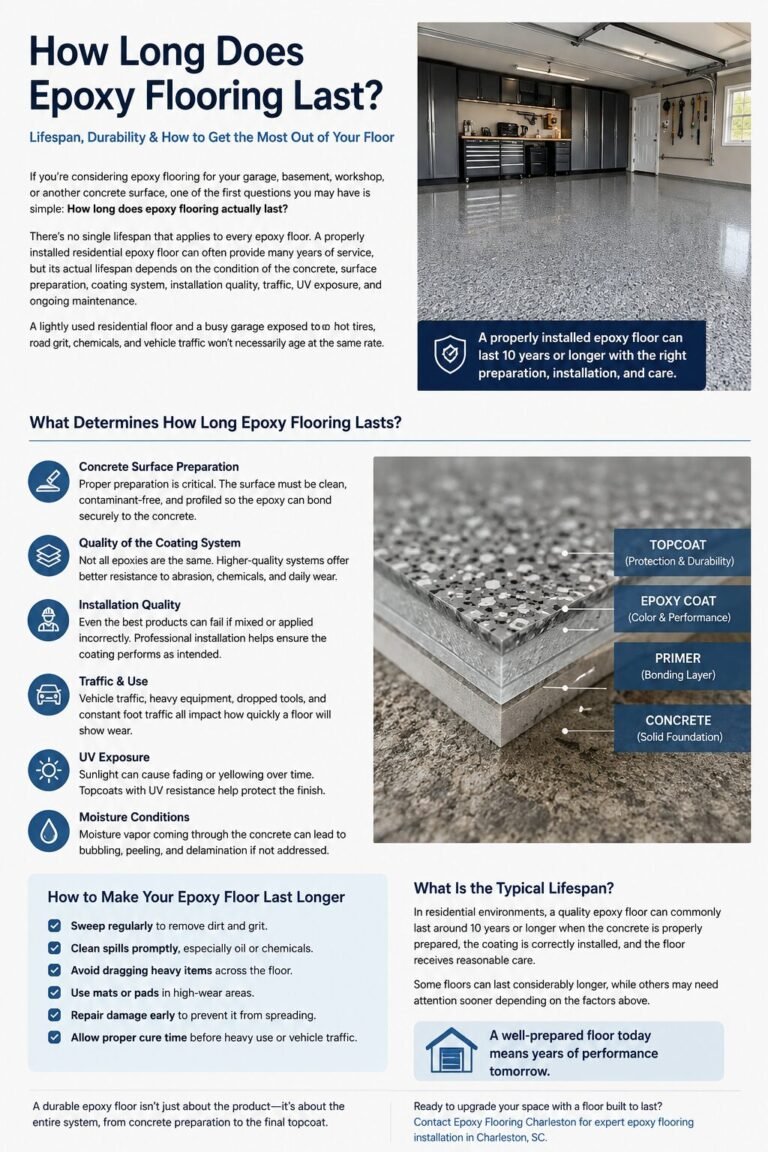
There isn’t one lifespan that applies to every garage floor.
Longevity depends on factors including:
- Concrete preparation
- Product quality
- Installation
- Vehicle traffic
- Abrasion
- Chemical exposure
- UV exposure
- Moisture conditions
- Maintenance
A properly prepared and professionally installed system can provide
many years of service, while a poorly bonded coating may fail much
sooner.
How
to Maintain a Coated Garage Floor in Coastal South Carolina
Routine maintenance can help reduce unnecessary wear.
Sweep Regularly
Remove sand, dirt, and grit before they are repeatedly ground into
the surface by tires and foot traffic.
Clean Spills Promptly
Don’t allow oil or automotive fluids to remain on the floor
unnecessarily.
Remove Standing Water
Wet floors can become slippery regardless of the coating system.
Avoid Dragging Heavy Metal
Objects
Dragging equipment can scratch or gouge coated surfaces.
Inspect the Floor
Occasionally
Look for peeling, unusual blistering, or other signs that may
indicate a problem requiring attention.
Frequently Asked Questions
Is epoxy
flooring good for South Carolina garages?
It can be. A properly selected epoxy-based coating system can work
well for residential garages when the concrete is appropriately prepared
and environmental and substrate conditions are considered.
Is
polyaspartic better than epoxy in humid climates?
Polyaspartic products can offer advantages in certain applications,
but humidity alone doesn’t determine which coating is best. The specific
products, substrate, installation conditions, UV exposure, and overall
flooring system should all be considered.
What
garage floor coating is best for Charleston’s heat?
Rather than choosing solely based on outdoor temperature, look for a
garage flooring system intended for vehicle traffic and installed
according to its environmental and substrate requirements.
Can garage
floor coatings handle Charleston humidity?
Appropriate professional coating systems can be installed in humid
climates, but manufacturers’ application conditions need to be followed.
Humidity in the air should also not be confused with moisture vapor
moving through the concrete slab.
Which garage
coating is best near the coast?
Look for a system that balances adhesion, abrasion resistance, UV
stability where needed, cleanability, and appropriate texture. Proper
concrete preparation remains critical regardless of the coating
chemistry.
Are
garage floor coatings easy to clean after sand gets inside?
Coated floors can generally be easier to sweep and clean than porous
bare concrete. Regularly removing sand and grit is recommended because
these particles can contribute to abrasion.
The Best Garage
Floor Starts With the Concrete
So, what is the best garage floor coating for coastal South
Carolina?
There isn’t a single product that wins in every garage.
For Charleston-area homes, a strong solution is generally a
properly prepared coating system selected around the condition
of the concrete, vehicle use, moisture, UV exposure, desired appearance,
and traction requirements.
Don’t choose your floor based only on the label printed on the
coating container.
Surface preparation and installation quality can make just as much
difference as the coating material itself.
If you’re considering a garage floor coating in Charleston,
SC, Epoxy Flooring Charleston can help evaluate your existing
concrete and determine an appropriate flooring approach for your garage
and coastal environment.
Explore our Garage Floor Coating services to learn
more about professionally prepared garage flooring for Charleston and
the surrounding Lowcountry.