Can You Epoxy a Garage Floor With Cracks?
Yes, you can epoxy a garage floor with cracks—but in most cases,
the cracks should be evaluated and properly repaired before the
coating is applied.
Applying epoxy directly over a cracked concrete floor doesn’t make
the underlying problem disappear. Depending on the type and movement of
the crack, it may eventually become visible through the coating or
contribute to failure around the damaged area.
The good news is that many garage floors have minor cracks, and they
don’t automatically prevent you from installing an epoxy floor.
The key is understanding what caused the crack, whether it is
still moving, and how the concrete should be prepared before
coating.
Here’s what homeowners should know before applying epoxy over a
cracked garage floor.
Can Epoxy Be Applied
Over Cracked Concrete?
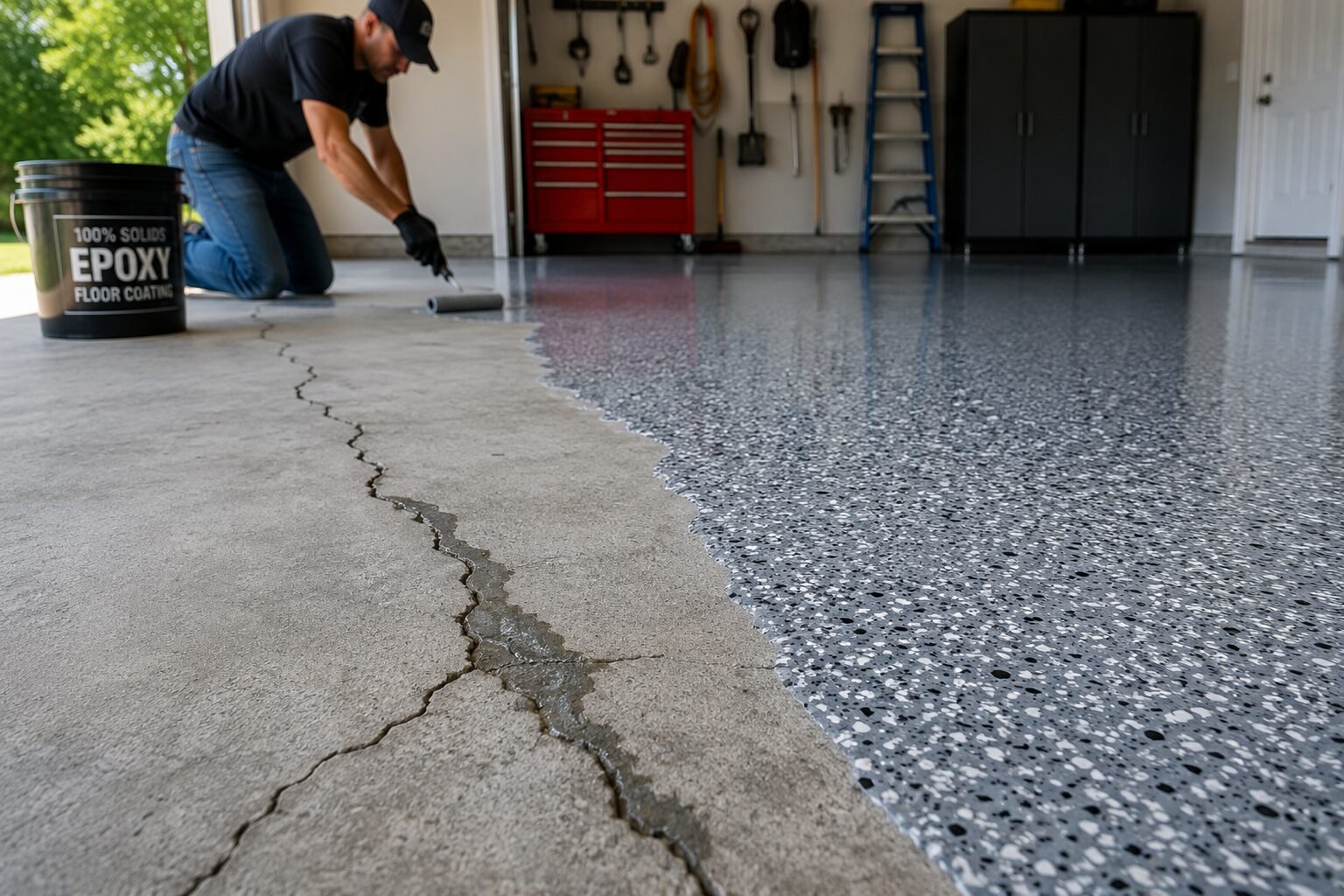
It can, but simply rolling epoxy over an untreated crack usually
isn’t the best approach.
Concrete naturally develops cracks for several reasons, including
shrinkage, settlement, temperature changes, and movement within the
slab.
Before installing a garage floor coating, the existing concrete
should be inspected.
Small, stable cracks may be repairable as part of the preparation
process. Larger, widening, uneven, or actively moving cracks may require
additional evaluation before a coating system is installed.
The goal isn’t just to hide the crack.
It’s to create a sound and appropriately prepared surface for the new
flooring system.
Why Do Garage Floors Crack?
Understanding why the concrete cracked can help determine what should
happen next.
Concrete Shrinkage
Concrete can shrink as it cures and loses moisture.
This can create relatively small cracks in a slab even when there
isn’t a major structural problem.
Temperature Changes
Concrete expands and contracts as environmental conditions
change.
Repeated movement can contribute to cracking over time.
Settlement
Movement or settlement beneath a concrete slab can cause
cracking.
Settlement-related cracks may require more attention, particularly
when one side of the crack is noticeably higher than the other.
Heavy Loads
Garages regularly support vehicles, equipment, storage systems, and
other heavy loads.
Depending on the slab and underlying conditions, loading can
contribute to existing concrete problems.
Poor Original Installation
Concrete thickness, reinforcement, subgrade preparation, curing, and
control-joint placement can all influence how a slab performs.
Problems with the original concrete installation may become visible
years later.
What Types of
Cracks Can Be Repaired Before Epoxy?
Not all concrete cracks should be treated the same way.
Hairline Cracks
Very small, stable cracks are common in concrete.
Depending on their condition, they can often be addressed during
preparation before the floor coating is installed.
Shrinkage Cracks
Stable cracks caused by concrete shrinkage may also be suitable for
repair.
The crack should still be inspected to make sure there isn’t evidence
of ongoing movement or another underlying issue.
Wider Cracks
Wider cracks generally require more preparation than simply filling
the visible opening at the surface.
The appropriate repair method depends on the width, depth, condition,
and cause of the crack.
Moving or Structural Cracks
These are different.
If a crack continues to widen, shows significant displacement, or
appears to be associated with structural movement, coating over it won’t
solve the underlying problem.
A qualified concrete or structural professional may need to evaluate
the slab before cosmetic flooring work proceeds.
Will Epoxy Fill Concrete
Cracks?
Epoxy flooring material itself shouldn’t be treated as a universal
crack-repair product.
A floor coating is designed primarily to create a finished
surface—not to correct every defect in the concrete underneath.
Cracks may require a separate repair material and preparation process
before the coating system is installed.
Simply allowing the floor coating to flow into an untreated crack may
leave a visible depression and doesn’t necessarily provide an
appropriate long-term repair.
What Happens If
You Epoxy Directly Over Cracks?
Sometimes the floor may initially look fine.
But if the underlying crack isn’t properly addressed, several
problems can occur.
The Crack May Become Visible
Again
If the concrete continues moving, the crack can eventually reflect
through the coating.
This is sometimes called reflective cracking.
The Coating May
Separate Around the Crack
Loose or damaged concrete around a crack can create a weak
substrate.
If the coating bonds to unstable material, sections may eventually
chip, peel, or delaminate.
The Finished Floor May Look
Uneven
Even when adhesion isn’t affected, untreated cracks can remain
visible underneath a coating and reduce the quality of the finished
appearance.
Moisture May Complicate the
Problem
Some cracks can provide pathways for moisture.
If moisture-related conditions are present, they should be evaluated
before applying a coating rather than simply sealing the visible crack
and covering it.
How Are
Garage Floor Cracks Prepared Before Epoxy?
The exact process depends on the crack, but professional preparation
generally involves more than wiping the floor clean and filling visible
lines.
Step 1: Inspect the Concrete
First, the condition of the slab should be evaluated.
The installer should consider:
- Crack width
- Crack depth
- Evidence of movement
- Unevenness across the crack
- Loose concrete
- Moisture concerns
- Existing coatings or sealers
This helps determine whether the crack is primarily a repair issue or
a sign of something more significant.
Step 2: Prepare the Crack
Depending on the repair system, the crack may need to be mechanically
opened or otherwise prepared so loose material is removed and the repair
product can properly bond.
Simply placing filler over dust or weak concrete can produce a poor
repair.
Step 3: Clean the Repair Area
Dust and debris created during preparation should be removed.
The repair material needs a clean, suitable surface.
Step 4: Apply the
Appropriate Repair Material
A compatible concrete crack-repair product is then installed
according to its requirements.
Different repair products are designed for different types of damage
and flooring systems.
Step 5: Level and Prepare
the Repair
Once cured as required, excess repair material may need to be ground
or otherwise prepared so the repaired section blends appropriately with
the surrounding floor.
Step 6: Prepare the
Entire Garage Floor
Crack repair is only one part of surface preparation.
The rest of the concrete still needs to be properly prepared for the
coating.
For many professional garage floor installations, this may include
diamond grinding to create an appropriate surface
profile and remove unsuitable surface material.
Step 7: Apply the Coating
System
Once repairs and preparation are complete, the selected primer, base
coat, decorative components, and/or topcoat can be installed according
to the flooring system being used.
Can Epoxy Stop a Crack
From Coming Back?
No coating can guarantee that an actively moving concrete crack will
never return.
Even when a crack is professionally repaired, movement in the slab
can cause it to become visible again.
This is why distinguishing between a stable crack
and an active crack matters.
If the slab itself continues moving, simply making the repair
material stronger doesn’t necessarily eliminate the forces causing the
movement.
Homeowners should be cautious of claims that a decorative floor
coating can permanently solve structural movement in concrete.
Should Control
Joints Be Filled Before Epoxy?
Control joints are not necessarily the same as random cracks.
They are intentionally placed in concrete to help manage where
shrinkage movement occurs.
Whether joints should remain visible, be filled, or receive another
treatment depends on the floor, joint type, expected movement, repair
system, and desired finished appearance.
Automatically filling every joint simply to create a seamless-looking
floor can create problems if movement isn’t considered.
The joint strategy should therefore be determined as part of the
overall floor preparation plan.
What About Uneven Cracks?
A crack where one side of the slab is noticeably higher than the
other deserves additional attention.
This type of displacement can indicate movement or settlement.
Grinding down the high side may improve appearance in some
situations, but it doesn’t necessarily address why the movement
occurred.
Significant displacement should be evaluated before proceeding with a
coating installation.
Can You Epoxy
a Garage Floor With Lots of Cracks?
Possibly.
The number of cracks alone doesn’t determine whether
a floor can be coated.
Their condition matters more.
A garage floor containing several stable shrinkage cracks may still
be a reasonable candidate after appropriate repairs and preparation.
A floor with widespread movement, severe deterioration, substantial
spalling, or significant displacement is a different situation.
In those cases, the concrete itself may require more extensive repair
before epoxy flooring should be considered.
Does Diamond Grinding Fix
Cracks?
No.
Diamond grinding and crack repair perform different jobs.
Diamond grinding mechanically prepares the concrete
surface for a coating.
Crack repair addresses damaged or separated sections
of the slab.
Both may be part of the same garage floor preparation process, but
grinding the surface doesn’t automatically repair cracks.
Likewise, repairing cracks doesn’t eliminate the need to prepare the
surrounding concrete.
Should You
Repair Cracks Before or After Grinding?
The exact sequence can depend on the floor, equipment, repair
material, and coating system.
Professional installers may perform initial mechanical preparation
before completing certain repairs because grinding can reveal defects
that weren’t obvious beforehand.
Repairs may then be completed and prepared so they integrate with the
surrounding floor.
The important point is that crack repair and surface
preparation should work together as part of one system, rather
than being treated as unrelated steps.
Can You DIY Epoxy a
Cracked Garage Floor?
It is possible to repair minor cracks and install some DIY coating
systems, but evaluating the concrete correctly is important.
Before attempting the project, determine:
- Whether the cracks appear stable
- Whether there is vertical displacement
- Whether the slab has moisture issues
- Whether oil or other contamination is present
- Whether an existing sealer or coating needs removal
- What surface profile the coating manufacturer requires
- Which repair materials are compatible with the coating
One of the biggest mistakes is spending significant time and money on
the visible epoxy while doing minimal work on the concrete underneath
it.
The finished coating can only perform as well as the substrate and
installation allow.
How Long Should
Crack Repairs Cure Before Epoxy?
There isn’t one cure time that applies to every crack-repair
product.
Some materials can be ready for additional preparation relatively
quickly, while others require considerably longer.
Follow the repair product manufacturer’s instructions for cure time,
temperature, preparation, and coating compatibility.
Applying the next layer too soon can compromise the repair or coating
system.
How to
Prevent Problems When Epoxying a Cracked Garage Floor
A successful installation comes down to proper evaluation and
preparation.
Before coating:
- Inspect cracks instead of simply covering them
- Determine whether cracks appear stable or active
- Address loose or damaged concrete
- Investigate significant displacement
- Consider moisture conditions
- Use compatible repair materials
- Prepare the concrete properly
- Follow coating application requirements
- Allow repairs and coatings to cure appropriately
These steps take more effort than simply painting over the floor, but
they’re important for long-term performance.
Cracked Garage Floors in
Charleston, SC
Concrete garage floors in Charleston can develop cracks just like
slabs in other parts of the country.
Heat, humidity, soil conditions, age, construction methods, and
normal concrete movement can all affect a garage slab over time.
Having cracks doesn’t automatically mean you need a new concrete
floor.
Many existing garage floors can potentially be repaired and prepared
before receiving a new coating.
The important part is determining what kind of cracks you’re
dealing with before covering them.
Frequently Asked Questions
Can I just fill
garage floor cracks with epoxy?
Don’t assume the floor coating itself is an appropriate crack filler.
Crack repairs should use a suitable repair method and compatible
material based on the condition of the concrete and coating system.
Will cracks show
through an epoxy floor?
They can. An untreated or moving crack may eventually become visible
through the coating. Proper repair can improve the result, but active
concrete movement can cause cracks to return.
Do all cracks
need to be repaired before epoxy?
Not every line in a concrete floor is necessarily the same type of
defect. Random cracks, control joints, construction joints, and other
features may require different treatments. The slab should be evaluated
before deciding what to fill.
Is a cracked garage
floor safe to epoxy?
Many garage floors with minor, stable cracks can be suitable
candidates after proper preparation and repair. Significant movement,
vertical displacement, or suspected structural problems should be
evaluated before coating.
Can epoxy repair structural
cracks?
A decorative epoxy floor coating should not be considered a
structural repair solution. Suspected structural cracks should be
evaluated and appropriately repaired before flooring work proceeds.
Why
did my crack come back after the garage floor was coated?
The concrete may have continued moving after the original repair.
Cracks can reflect through a coating when the underlying slab continues
to expand, contract, settle, or otherwise move.
Don’t
Cover Garage Floor Cracks Without Evaluating Them
So, can you epoxy a garage floor with cracks?
In many cases, yes.
Minor and stable concrete cracks can often be repaired as part of the
floor preparation process before a garage floor coating is
installed.
But epoxy shouldn’t simply be used to hide damaged concrete.
If cracks are widening, moving, significantly uneven, or associated
with other signs of slab problems, the underlying cause should be
investigated first.
For homeowners considering a garage floor coating in
Charleston, SC, proper crack repair and concrete preparation
can make an important difference in how the finished floor looks and
performs.
Epoxy Flooring Charleston can evaluate your existing garage floor,
address appropriate surface repairs, prepare the concrete, and install a
coating system designed for your space.
Explore our Garage Floor Coating services to learn
more about transforming an existing Charleston garage floor.