Why Epoxy Floors Turn Yellow & How UV Exposure Affects Them
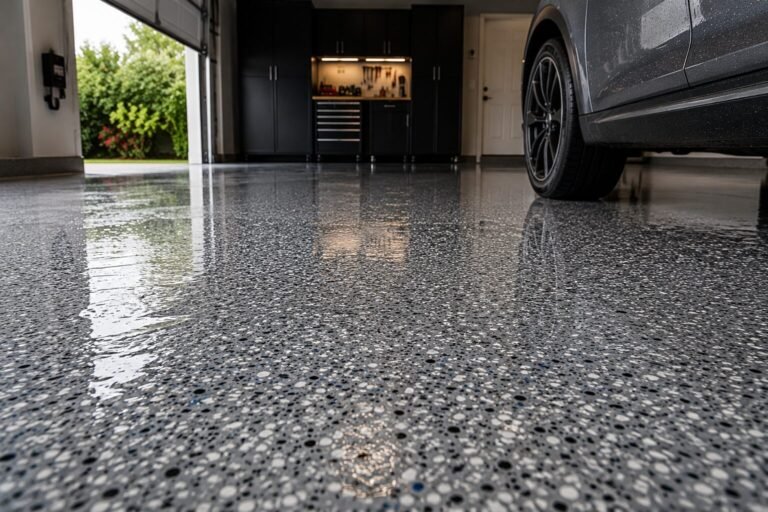
A freshly installed epoxy floor can have a bright, clean finish. But
after months or years, some homeowners notice that parts of the floor
have developed a yellow, amber, or uneven appearance.
This is commonly known as epoxy yellowing or
ambering.
One of the biggest causes is exposure to ultraviolet (UV) light from
the sun. Certain epoxy formulations can gradually change color when
exposed to UV radiation, particularly in areas receiving regular direct
sunlight.
That doesn’t necessarily mean the floor has lost its bond to the
concrete or stopped functioning. In many cases, yellowing is primarily
an appearance issue.
However, understanding why it happens can help you choose the right
flooring system and reduce unwanted discoloration.
Why Does Epoxy Flooring
Turn Yellow?
Epoxy flooring is created through a chemical reaction between resin
and hardener components.
After curing, the coating forms a hard surface. But certain epoxy
chemistry can still be affected by prolonged UV exposure.
Over time, UV radiation can contribute to chemical changes within the
coating that alter its appearance.
Instead of maintaining its original clear or light-colored
appearance, the epoxy may begin to look:
- Yellow
- Amber
- Darker
- Unevenly colored
- Different in sun-exposed areas
This process is often called ambering.
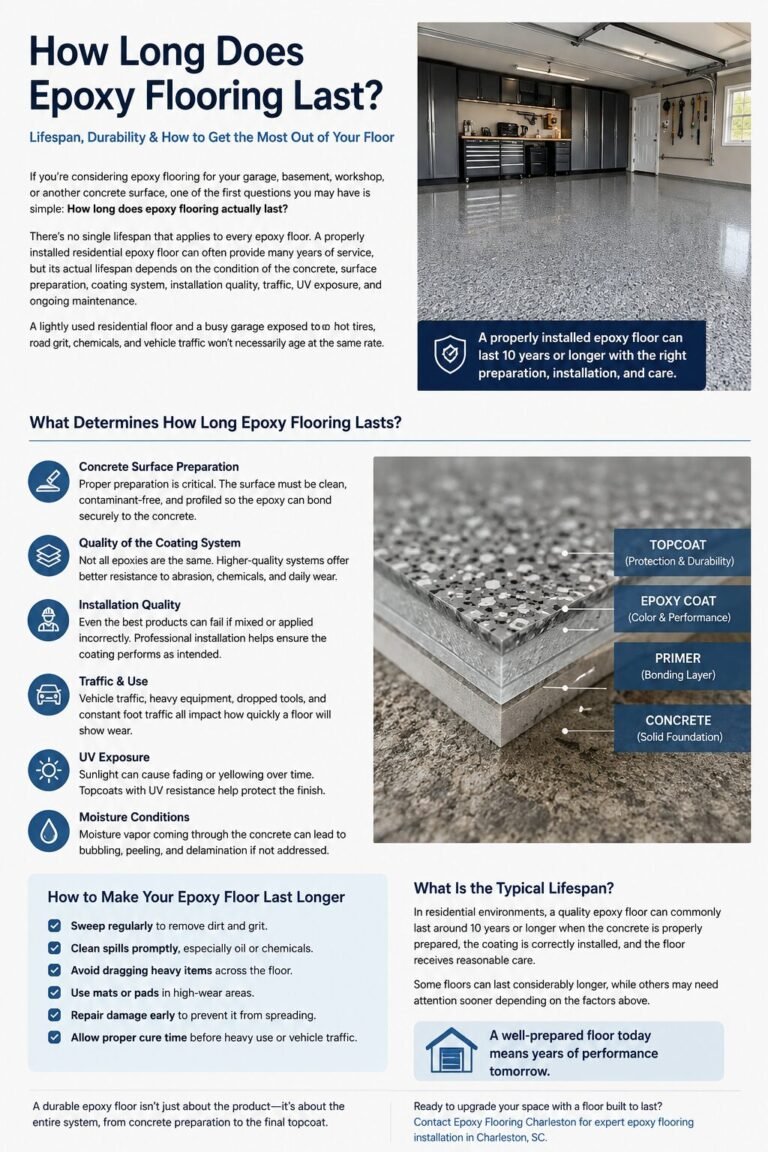
The severity depends on the specific product, amount of UV exposure,
coating system, color, and environmental conditions.
How Does UV Light Affect
Epoxy?
Sunlight contains ultraviolet radiation.
When UV radiation repeatedly reaches certain epoxy coatings, it can
gradually affect the material’s appearance.
The change usually doesn’t happen overnight.
Instead, you might notice that the section near a garage door slowly
develops a different color from the rest of the floor.
This can become particularly noticeable when the garage door stays
open frequently.
Why Does Epoxy
Yellow Near the Garage Door?
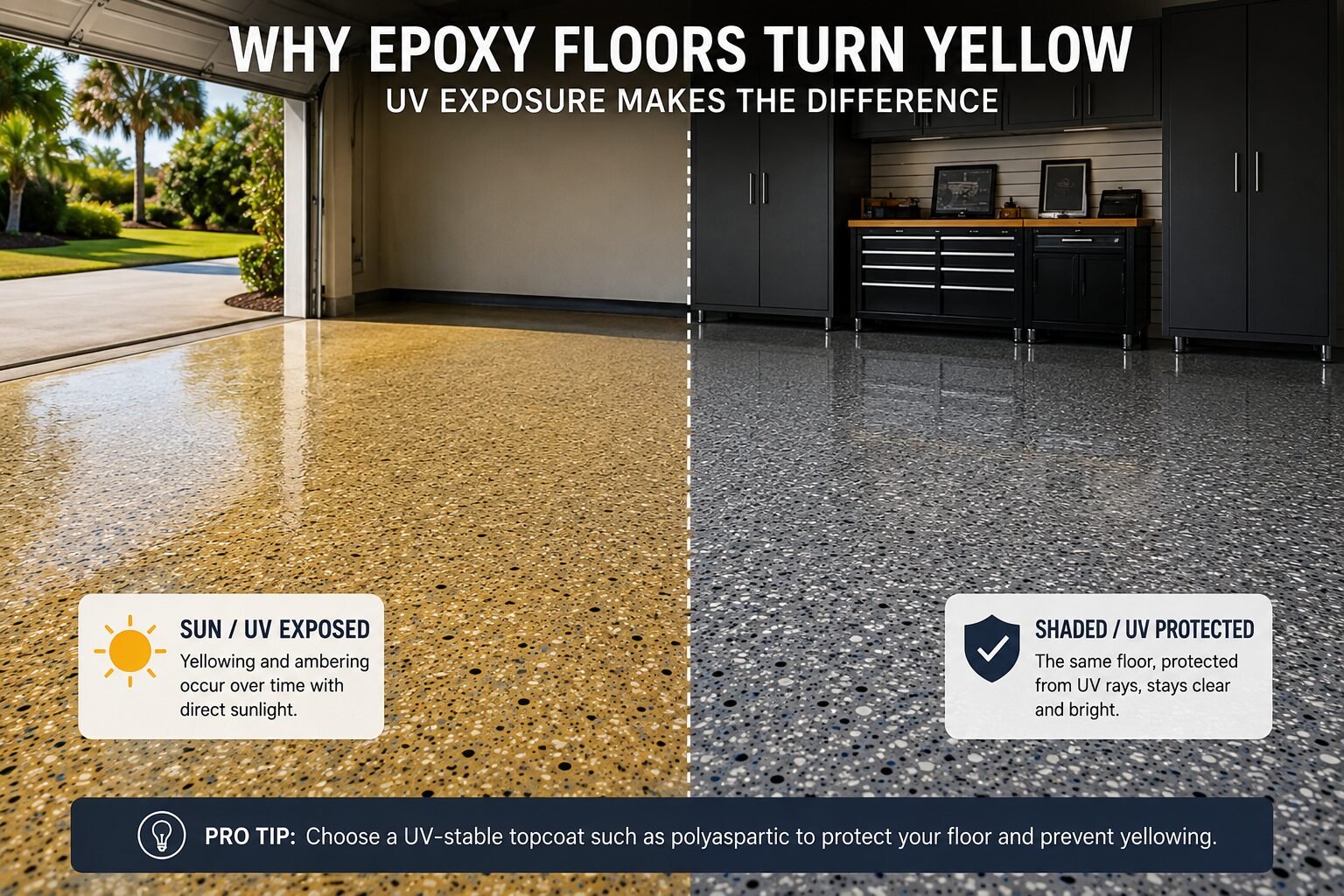
The front portion of a garage often receives much more sunlight than
the back.
Imagine a garage door that’s regularly left open during the
afternoon.
The first several feet of flooring might receive direct sunlight,
while the back half remains shaded.
After enough UV exposure, you may begin seeing a visible difference
between the two areas.
You could even notice a fairly distinct line corresponding to where
sunlight regularly reaches.
This is one reason UV exposure should be considered when choosing a
garage floor coating, particularly in sunny
environments.
Does All Epoxy Turn Yellow?
Not every epoxy product responds to UV exposure in exactly the same
way.
Formulations vary considerably.
However, epoxy as a general coating category is known to have
potential UV-stability limitations compared with some other coating
chemistries.
That’s why professional flooring systems may use different products
for different layers.
For example, epoxy may provide useful characteristics within a
flooring system while another compatible material is selected for the
exposed finish.
Rather than asking only, “Is this epoxy?”,
homeowners should consider the entire coating system.
Does Yellow Epoxy
Mean the Floor Has Failed?
Not necessarily.
This distinction is important.
Yellowing is often primarily cosmetic.
A floor can change color while remaining firmly attached to the
concrete underneath.
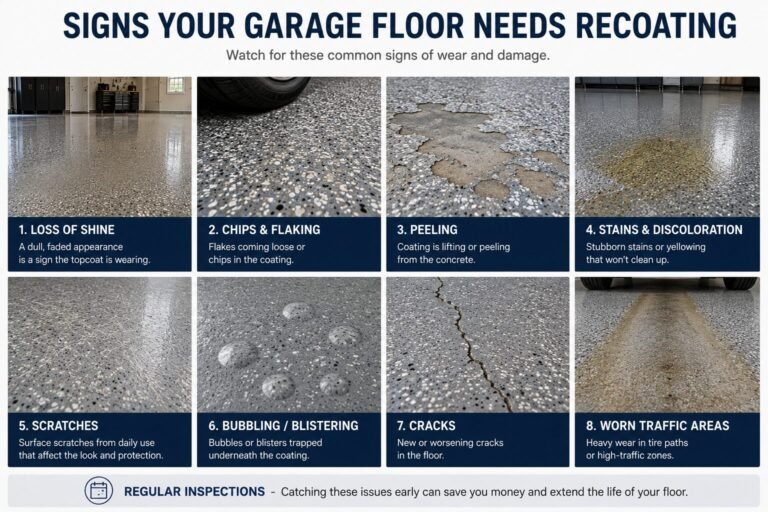
Coating failure involves problems such as:
- Peeling
- Delamination
- Blistering
- Loss of adhesion
- Significant deterioration
If your floor is securely bonded but has changed color near a sunny
garage entrance, UV exposure may be affecting its appearance without
necessarily indicating an adhesion failure.
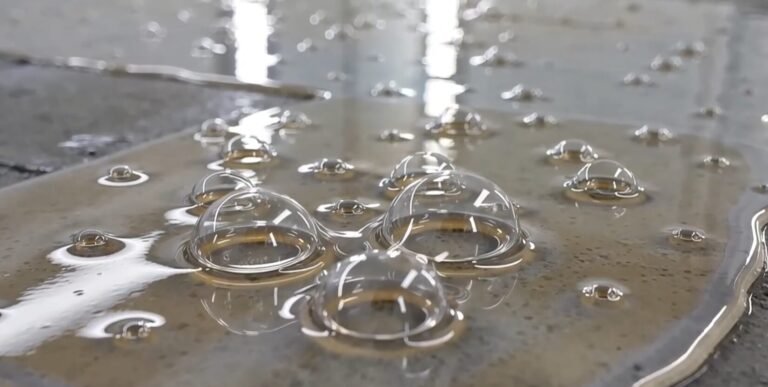
On the other hand, if discoloration is accompanied by peeling,
bubbles, or other defects, additional investigation may be
appropriate.
What Other
Things Can Cause Epoxy Discoloration?
UV light isn’t the only possible explanation.
Several other factors can change how an epoxy floor looks.
Chemical Exposure
Garage floors may encounter:
- Oil
- Fuel
- Automotive fluids
- Cleaning chemicals
- Household chemicals
Depending on the substance and coating, prolonged exposure may
contribute to staining or discoloration.
Heat
Heat and environmental conditions can potentially affect some coating
systems.
The specific response depends on the product and circumstances.
Incorrect Mixing
Two-component coatings depend on proper mixing.
Incorrect ratios, incomplete mixing, or application errors can result
in inconsistent curing or appearance.
Different Application
Conditions
If different areas or coating batches were installed under different
conditions, variations in appearance may become noticeable.
Aging
Floor coatings naturally age.
Even without severe direct sunlight, appearance can change gradually
over a long service life.
Is Yellowing More
Noticeable on Clear Epoxy?
It can be.
Clear and very light-colored coatings can make ambering easier to see
because there is little color to disguise the change.
On darker or heavily decorative floors, subtle color changes may be
less obvious.
This doesn’t necessarily mean dark coatings are more UV
resistant.
They may simply make certain appearance changes harder to notice.
What About White Epoxy
Floors?
White and very light flooring systems can make discoloration
particularly noticeable.
Even a relatively small shift toward yellow or amber may stand out
against the original bright color.
If you’re considering a very light garage floor in an area that
receives substantial sunlight, UV stability should be discussed before
choosing the coating system.
Can You Prevent Epoxy
From Turning Yellow?
You may not be able to eliminate every possible appearance change
over the life of a floor, but you can reduce UV-related concerns by
considering sunlight exposure during system selection.
Choose the
Complete Coating System Carefully
Don’t select flooring based solely on the base coat.
Ask what products will form the entire system, including the final
exposed layer.
The layer receiving direct sunlight is particularly important when UV
exposure is expected.
Consider a UV-Stable Topcoat
Depending on the flooring system, a more UV-stable compatible finish
may be used over epoxy.
Polyaspartic and certain other coating technologies are commonly
considered where UV stability is an important requirement.
The exact products should be selected for compatibility and intended
use.
Consider Decorative Flakes
Decorative flake systems provide substantial color variation.
Although flakes don’t make the underlying chemistry immune to UV
radiation, a properly designed flake system with an appropriate finish
can offer an attractive garage-floor solution where appearance is
important.
Consider Garage Orientation
Look at how sunlight enters your garage.
Ask yourself:
- Does direct sunlight reach the floor?
- For how many hours?
- Is the garage door frequently left open?
- Which areas receive the most exposure?
These simple observations can help determine how important UV
resistance should be when selecting your flooring system.
What Is a UV-Stable
Garage Floor Coating?
When a coating is described as UV stable or UV resistant, it
generally means it’s formulated to better resist appearance degradation
caused by ultraviolet exposure than less UV-stable alternatives.
However, terms such as “UV resistant” shouldn’t automatically be
interpreted as meaning a floor can never change appearance.
Product performance varies.
If sunlight exposure is a major concern, compare the actual coating
systems and manufacturer specifications rather than relying only on
marketing labels.
Epoxy vs. Polyaspartic
for UV Exposure
Homeowners researching garage floors often come across comparisons
between epoxy and polyaspartic coatings.
One commonly discussed difference is UV stability.
Certain polyaspartic formulations can provide better resistance to
UV-related discoloration than conventional epoxy.
That doesn’t automatically make polyaspartic “better” for every part
of every garage floor.
A professional system may use different coating technologies for
different purposes.
The best solution depends on:
- Concrete condition
- Surface preparation
- UV exposure
- Vehicle traffic
- Desired appearance
- Cure requirements
- Chemical exposure
- Overall system compatibility
The goal should be to build the right system, not
simply choose whichever coating name sounds best.
Can Yellow Epoxy Be Fixed?
Potentially, depending on the condition of the floor.
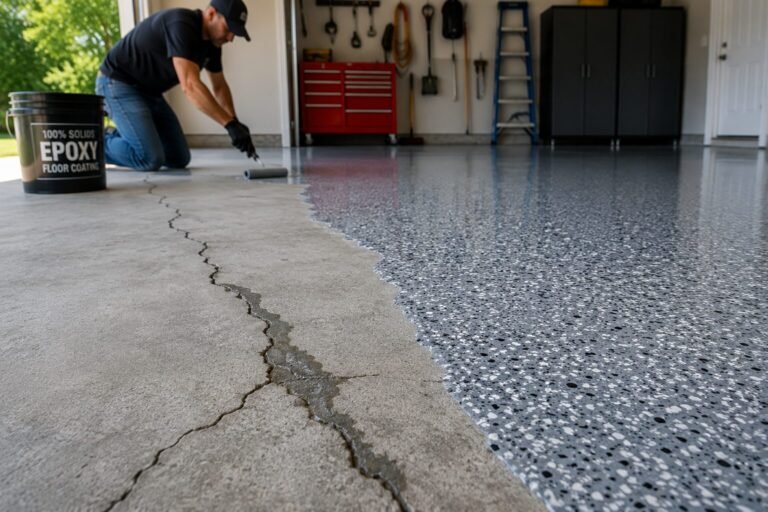
If discoloration is limited to the surface and the existing coating
remains firmly bonded, a compatible recoating solution may sometimes
refresh the appearance.
But the floor must first be evaluated.
Applying another coating without proper preparation can create
adhesion problems.
An existing floor may need:
- Cleaning
- Contaminant removal
- Inspection for damage
- Repairs where necessary
- Mechanical surface preparation
- Application of a compatible new coating
If UV exposure caused the original appearance problem, the
replacement or recoating system should account for that exposure.
Otherwise, the same issue may eventually return.
Should You Replace a
Yellow Epoxy Floor?
Not automatically.
If the only problem is color change and the floor remains securely
bonded, complete removal may not be necessary.
Ask three questions:
Is the coating still securely bonded?
Is the discoloration purely cosmetic?
Can the existing system accept a compatible new coating after
preparation?
If the floor is also peeling, blistering, or delaminating, then the
underlying problem needs to be investigated before deciding what to do
next.
How Can You Tell UV
Yellowing From a Stain?
Look at the pattern.
UV-related discoloration may follow areas that regularly receive
sunlight.
For example, the front of the garage may appear more amber while the
shaded rear section retains its original appearance.
A chemical stain is more likely to be localized around a spill or
specific contact area.
Cleaning may help determine whether discoloration is on the surface,
but avoid aggressive chemicals unless they’re compatible with your
flooring system.
If the color change is within the coating itself, ordinary cleaning
won’t restore the original color.
Does Keeping the
Garage Door Closed Help?
Reducing direct sunlight can reduce UV exposure.
Keeping the garage door closed when the garage isn’t being used may
therefore limit unnecessary direct sunlight reaching the floor.
However, homeowners shouldn’t have to design their entire routine
around protecting the coating.
If significant sunlight exposure is expected, selecting an
appropriate flooring system from the beginning is a better long-term
strategy.
UV Exposure and
Garage Floors in Charleston, SC
UV resistance is particularly worth considering for garage floors in
Charleston and coastal South Carolina.
Homes in the area can experience strong sunlight alongside warm
conditions for much of the year.
Depending on the orientation of your garage, direct sunlight may
reach several feet inside whenever the door is open.
For Charleston homeowners choosing an epoxy or garage floor coating,
consider:
- How much sunlight enters the garage
- The direction the garage faces
- How often the door stays open
- The floor color
- The coating used as the exposed finish
These details can influence how the floor looks as it ages.
Frequently Asked Questions
Why did my clear epoxy turn
yellow?
UV exposure is a common cause of yellowing or ambering in certain
epoxy formulations. Chemical exposure, aging, and installation factors
can also contribute to discoloration.
How quickly does
epoxy turn yellow in sunlight?
There isn’t one universal timeline. It depends on the epoxy
formulation, intensity and duration of UV exposure, coating thickness,
environmental conditions, and other factors.
Can yellow epoxy become
clear again?
If the color change occurred within the cured coating due to UV
exposure, normal cleaning generally won’t reverse it. Depending on the
condition of the floor, preparation and recoating may be an option.
Does epoxy yellow indoors?
It can experience appearance changes over time, although floors
protected from direct UV exposure may behave differently from surfaces
receiving regular sunlight. Product formulation and environmental
conditions also matter.
Does a clear
topcoat stop epoxy from yellowing?
Not simply because it’s clear. The UV characteristics of the actual
topcoat matter. A compatible finish specifically selected for better UV
stability may help protect the overall appearance.
Are
decorative flake garage floors affected by UV?
The complete coating system can be affected by sunlight depending on
the products used. Decorative flakes provide color variation, but the
exposed coating layers should still be selected with UV exposure in
mind.
Does yellowing mean epoxy
is peeling?
No. Yellowing is usually an appearance change, while peeling
indicates loss of adhesion. A floor can be discolored while still
remaining securely bonded.
Protect
Your Garage Floor From More Than Everyday Wear
So, why do epoxy floors turn yellow?
One of the primary reasons is prolonged UV exposure,
which can cause certain epoxy formulations to gradually develop a yellow
or amber appearance.
The good news is that yellowing doesn’t automatically mean the entire
floor has failed.
More importantly, UV exposure can be considered before the floor is
installed.
Choosing an appropriate coating system—including a suitable exposed
finish—can help maintain the appearance of garage flooring in areas that
receive regular sunlight.
For homeowners considering a garage floor coating in Charleston, SC, Epoxy Flooring Charleston can help you explore
coating options based on your concrete, garage conditions, desired
appearance, and expected sunlight exposure.
Explore our Garage Floor Coating services to learn
more about creating a durable, attractive garage floor for your
Charleston home.