Are Epoxy Garage Floors Slippery When Wet?
Epoxy garage floors are known for their smooth appearance,
durability, and easy-to-clean surface. But that smooth finish raises an
important question:
Are epoxy garage floors slippery when wet?
The short answer is yes, a smooth epoxy floor can become
slippery when wet, just like many other hard flooring surfaces.
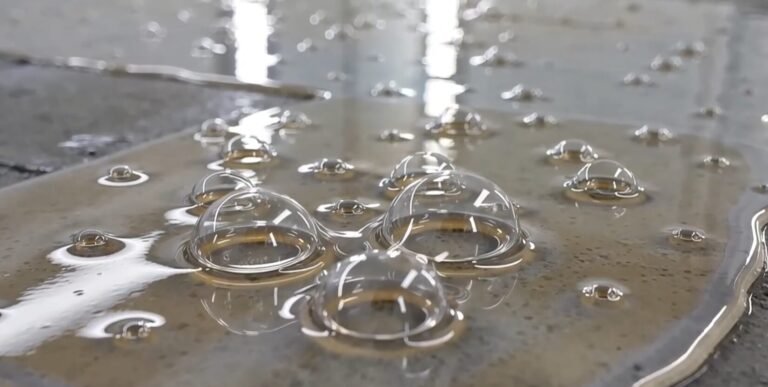
Water, oil, soap, and other liquids can reduce traction, especially on a
glossy coating.
However, that doesn’t mean every epoxy garage floor has to be
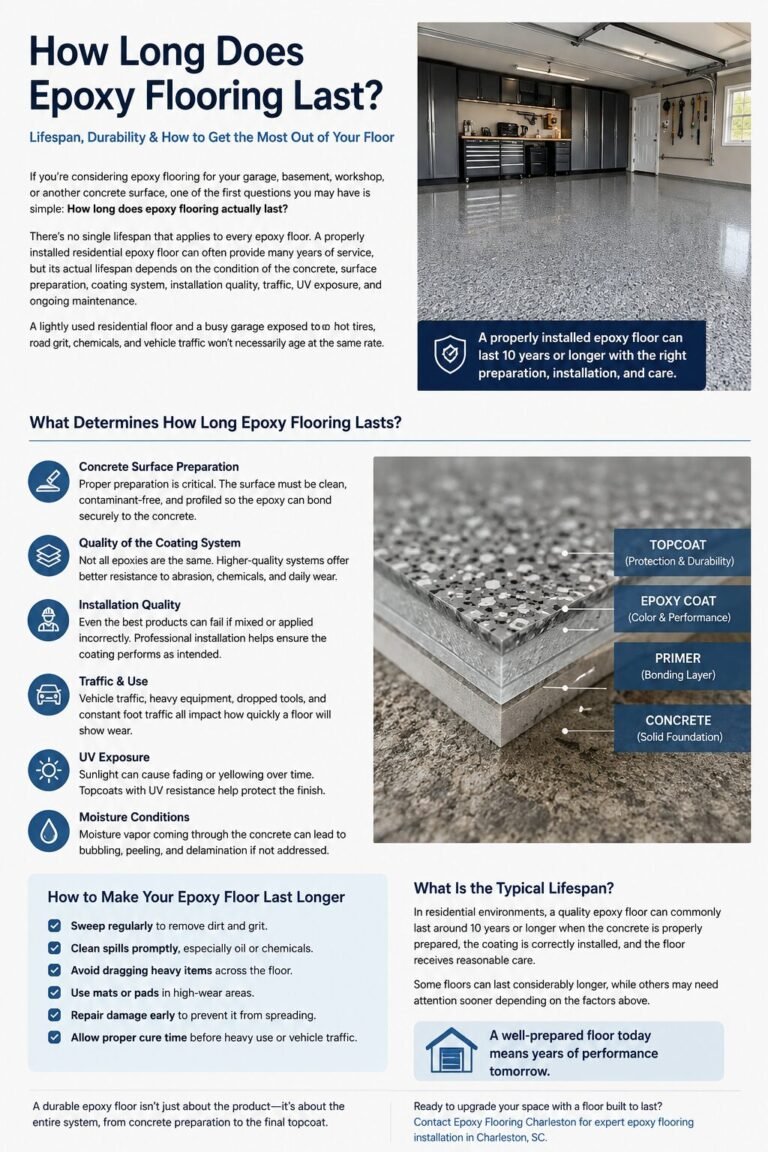
dangerously slippery. The amount of traction depends heavily on the
coating system, surface texture, additives, maintenance, and conditions
in the garage.
If slip resistance is a priority, there are several ways to create
more texture and grip in the finished floor.
\n
Why Can Epoxy Floors
Become Slippery?
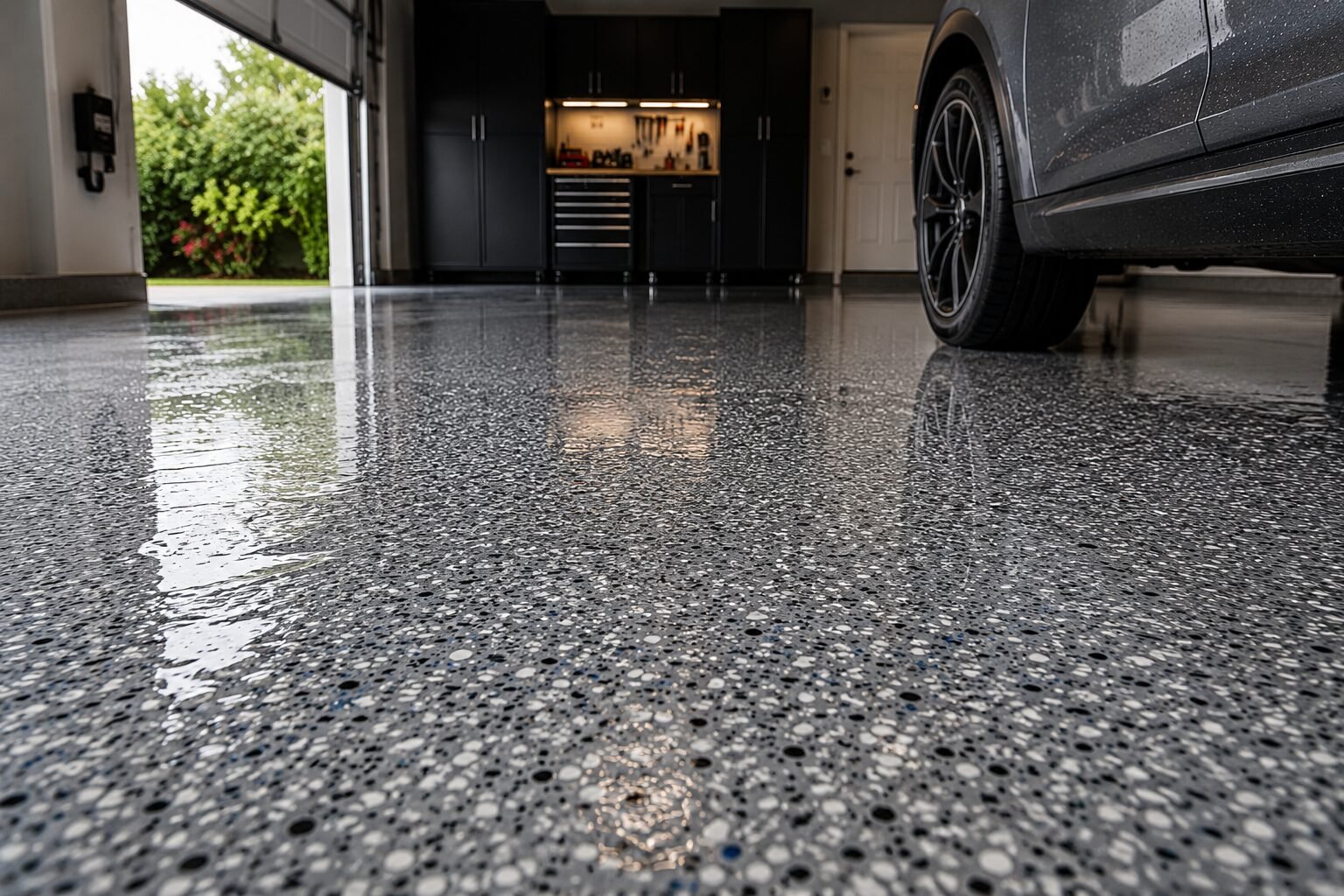
A smooth epoxy coating creates a relatively seamless surface.
That’s one of the reasons epoxy floors are easy to clean—but a very
smooth surface can provide less traction when liquid is present.
Imagine walking across smooth tile with wet shoes. The tile itself
hasn’t changed, but the layer of water between your shoe and the surface
can reduce grip.
A similar situation can occur with a smooth garage floor coating.
The risk may increase when the floor has:
- Standing water
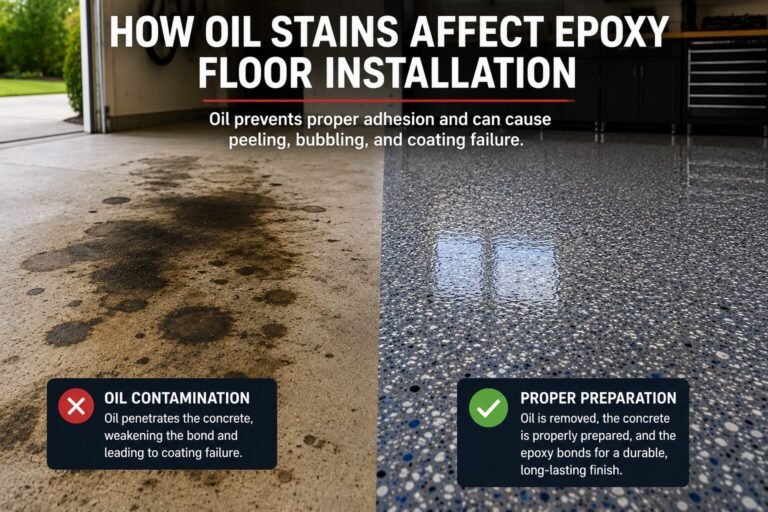
- Oil
- Automotive fluids
- Soap or cleaning residue
- Mud
- A very smooth glossy finish
This is why the intended use of the garage should be considered when
selecting a coating system.
Does a Glossy Epoxy
Floor Mean It’s Slippery?
Not necessarily.
Gloss and slip resistance aren’t exactly the same thing.
However, an extremely smooth coating can provide less traction under
wet conditions than a surface containing additional texture.
If your garage regularly gets wet from vehicles, washing, outdoor
equipment, or weather, you may want to consider a coating system
designed with additional surface texture.
You don’t necessarily have to give up an attractive finish to improve
traction.
How Can
You Make an Epoxy Garage Floor Less Slippery?
There are several ways to increase texture in a coated garage
floor.
1. Use an Anti-Slip Additive
Slip-resistant aggregate or other compatible additives can be
incorporated into certain coating systems.
These materials create microscopic or visible texture in the finished
surface, helping increase traction.
The appropriate additive and amount depend on the coating system and
how the floor will be used.
Adding more texture isn’t automatically better.
An excessively aggressive surface can become uncomfortable to walk on
and harder to clean.
The objective is to find a practical balance between traction
and cleanability.
2. Choose a Decorative Flake
Floor
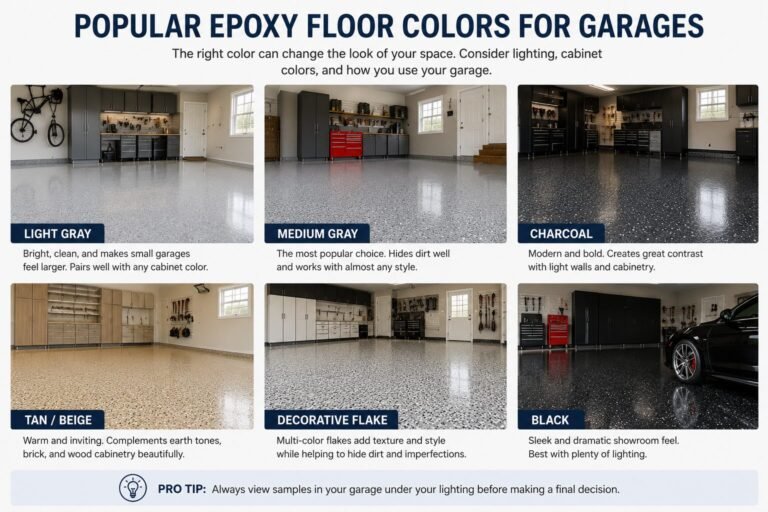
Decorative flakes aren’t only about appearance. If you are still comparing finishes, see our guide on how to choose an epoxy floor color for your garage.
Depending on the flooring system and application, flakes can
contribute texture to the surface rather than leaving it completely
smooth.
Flake systems are popular in residential garages because they can
combine:
- Attractive appearance
- Visual texture
- Color variation
- Practical everyday use
They can also help visually disguise small amounts of dirt and debris
between cleanings.
3. Select the Right Topcoat
The final layer of a garage floor system can influence both
appearance and surface characteristics.
Different topcoats and additives can produce different levels of
texture.
If slip resistance is important, discuss that requirement before
installation rather than waiting until the finished floor feels too
smooth.
4. Clean Spills Quickly
Even a textured floor can become slippery when covered with oil,
soap, or another slick substance.
Clean spills as soon as practical.
Pay particular attention to:
- Motor oil
- Automotive fluids
- Detergents
- Grease
- Water
- Mud
Keeping the floor clean helps the existing texture provide the
traction it was designed to provide.
5. Avoid Leaving Standing
Water
Garages can get wet for many reasons.
Rainwater can enter on vehicles. Cars may drip after being washed.
Outdoor equipment can bring moisture inside.
Whenever practical, remove standing water rather than allowing
puddles to remain.
This is good practice regardless of what type of garage flooring you
have.
Are Epoxy Floors Slippery
With Oil?
Oil can make almost any smooth flooring surface more slippery.
Epoxy is no exception.
If oil or another automotive fluid spills onto the garage floor,
avoid walking through the area unnecessarily and clean it using a method
appropriate for the particular coating.
One advantage of a properly installed coated floor is that spills can
often be easier to clean than on bare porous concrete.
That doesn’t mean spills should be ignored.
Are Epoxy Floors
Slippery With Snow or Rain?
Water carried into the garage by a vehicle can temporarily reduce
traction.
In areas where snow is common, melting snow can create additional
water on the floor.
Charleston homeowners are more likely to deal with rain and moisture
than snow, but the same basic principle applies.
A garage that regularly receives wet vehicles should have traction
considered during coating selection.
What About Bare Concrete?
It’s important to remember that bare concrete isn’t automatically
slip-proof.
Smooth or sealed concrete can also become slippery when wet.
The question shouldn’t simply be:
“Is epoxy slippery?”
A better question is:
“What surface characteristics are appropriate for how this
garage will actually be used?”
A properly designed coating system can incorporate texture according
to the conditions expected in the space.
Does Adding
Texture Make Epoxy Harder to Clean?
Potentially.
This is one of the tradeoffs when selecting slip resistance.
A perfectly smooth surface is generally easier to wipe or mop because
there are fewer textured areas where dirt can collect.
As texture increases, cleaning may require slightly more effort.
That’s why residential garages usually don’t need the most aggressive
possible anti-slip texture.
The ideal surface should provide a practical balance between:
Traction + appearance + comfort + cleanability.
Do Decorative
Flakes Make Epoxy Less Slippery?
Decorative flakes can contribute surface texture, depending on how
they’re applied and how the final topcoat is installed.
However, you shouldn’t assume that every flake floor automatically
provides a particular level of slip resistance.
The complete flooring system matters.
If traction is a major concern, it should be discussed when choosing
the system so the appropriate finish or additive can be considered.
Is Epoxy Safe for Families?
A properly designed garage floor coating can be a practical option
for residential garages.
If your garage is frequently used by:
- Children
- Older adults
- Pets
- Home gym users
- People working on vehicles
then traction may deserve additional consideration.
Tell your installer how the garage will be used.
A garage used only for parking may have different requirements from
one that doubles as a gym, workshop, or frequently used entrance to the
home.
What Areas of a
Garage Need the Most Traction?
Some areas deserve particular attention.
Garage Entrance
Water can enter when the garage door is open or when wet vehicles
drive inside.
Around Vehicles
Cars can bring in water and automotive fluids.
Workbench Areas
Oil, grease, and other substances may occasionally reach the
floor.
Entry Door
If your family regularly enters the house through the garage, this
area receives frequent foot traffic.
Washing Areas
If vehicles or equipment are washed inside the garage, the floor may
regularly become wet.
Considering these areas before installation can help you choose an
appropriate finish.
Can
You Add Anti-Slip Texture to an Existing Epoxy Floor?
In some situations, an existing coated floor may be recoated with a
compatible system that incorporates additional texture.
However, you shouldn’t simply apply another product over the floor
without preparation.
The existing coating should first be evaluated for:
- Adhesion
- Condition
- Contamination
- Compatibility
- Damage
The surface will generally require appropriate preparation before
another coating is installed.
If the existing floor is peeling, bubbling, or delaminating, those
problems should be investigated rather than simply covered.
How Do You Clean
a Textured Epoxy Garage Floor?
Regular maintenance is fairly straightforward.
Start by removing loose dirt and grit with a soft broom, dust mop, or
suitable vacuum.
For deeper cleaning, use a cleaning method compatible with your
coating system.
Avoid leaving soap residue behind.
Too much detergent can leave a film on the surface that may actually
make the floor feel more slippery.
After cleaning, rinse or remove residue as appropriate and allow the
floor to dry.
Are Epoxy Garage Floors
Safe When Wet?
No hard flooring surface should be assumed to be completely
slip-proof when wet.
Epoxy can become slippery when water, oil, soap, or other liquids are
present—particularly if the surface is very smooth.
However, surface texture, decorative flakes, compatible
anti-slip additives, appropriate coating selection, and proper
maintenance can improve traction.
If your garage frequently gets wet, make slip resistance part of the
flooring decision from the beginning.
Epoxy Garage Floors in
Charleston, SC
Charleston’s warm and humid climate means garage floors may regularly
encounter rainwater, moisture, wet tires, sand, and dirt carried in from
outdoors.
For local homeowners, it makes sense to consider both appearance and
practicality when choosing a garage floor coating.
A beautiful high-gloss floor may look impressive, but the best
flooring system is one suited to how your garage is actually used.
If wet vehicles frequently enter your garage or the space serves as a
primary entrance to your home, discuss traction and surface texture
before installation.
Frequently Asked Questions
Is epoxy more slippery
than concrete?
It depends on the surfaces being compared. Very smooth epoxy can
become slippery when wet, but smooth or sealed concrete can also lose
traction. Texture and surface conditions are more important than simply
comparing the names of the materials.
Can you put anti-slip
material in epoxy?
Compatible slip-resistant aggregates or additives can be incorporated
into certain flooring systems to increase surface texture. The
appropriate product and amount depend on the coating and intended
use.
Are epoxy flakes anti-slip?
Decorative flakes can contribute texture, but a flake floor shouldn’t
automatically be assumed to meet a particular slip-resistance
requirement. The complete coating system and finished texture
matter.
Is epoxy slippery for dogs?
Very smooth flooring can provide less traction for some pets,
especially when wet. If pets frequently use the garage, additional
texture may be worth considering.
Does epoxy become slippery
when oily?
Yes. Oil can reduce traction on epoxy and many other flooring
materials. Automotive fluid spills should be cleaned promptly.
Can I make my
existing epoxy floor less slippery?
Potentially. Depending on the condition and compatibility of the
existing coating, it may be possible to prepare and recoat the floor
using a system with additional texture. The existing floor should be
evaluated first.
Choose a Garage Floor
for Real-World Use
So, are epoxy garage floors slippery when wet?
They can be—particularly when the surface is extremely smooth or when
water, oil, or cleaning residue is present.
But slipperiness isn’t determined by the word “epoxy” alone.
Surface texture, coating selection, additives, maintenance,
and how the garage is used all matter.
If you’re considering a garage floor coating in Charleston,
SC, Epoxy Flooring Charleston can help you explore flooring
options that balance durability, appearance, cleanability, and
traction.
Explore our Garage Floor Coating services to learn
more about creating a garage floor suited to everyday use.